
What environmental investigations are required before upgrading a wastewater treatment plant in Queensland?
Before upgrading a wastewater treatment plant (WWTP) in Queensland, you typically need a contaminated land investigation (CLI), a hazardous building materials (HBM) survey and a PFAS assessment. These characterise soil and groundwater conditions, identify asbestos and other hazardous materials in existing structures, classify construction spoil for waste disposal, and inform dewatering design. Getting this right before construction begins is essential for regulatory compliance and cost certainty.
Why a WWTP Upgrade Needs a Contaminated Land Investigation First
Ageing wastewater treatment plants are a fact of life for local councils. When a south-east Queensland council committed to a major upgrade program across its WWTPs, the first question was not how to build better. It was what exactly is already in the ground.
Decades of industrial-scale sewage treatment can leave a complex environmental legacy: petroleum hydrocarbons, heavy metals, PFAS, acid sulfate soils and asbestos-containing materials in ageing infrastructure. Miss any of these during the design phase and the result is costly surprises mid-construction, dewatering management headaches and potential regulatory penalties. The council needed a thorough baseline before a single machine was moved into position.
Contaminated Land Investigation and HBM Survey Scope
iEnvi was engaged through a competitive tender under a Queensland Government procurement arrangement to undertake contaminated land investigations and hazardous building material surveys across multiple WWTP sites and associated sewage transfer main corridors in south-east Queensland.
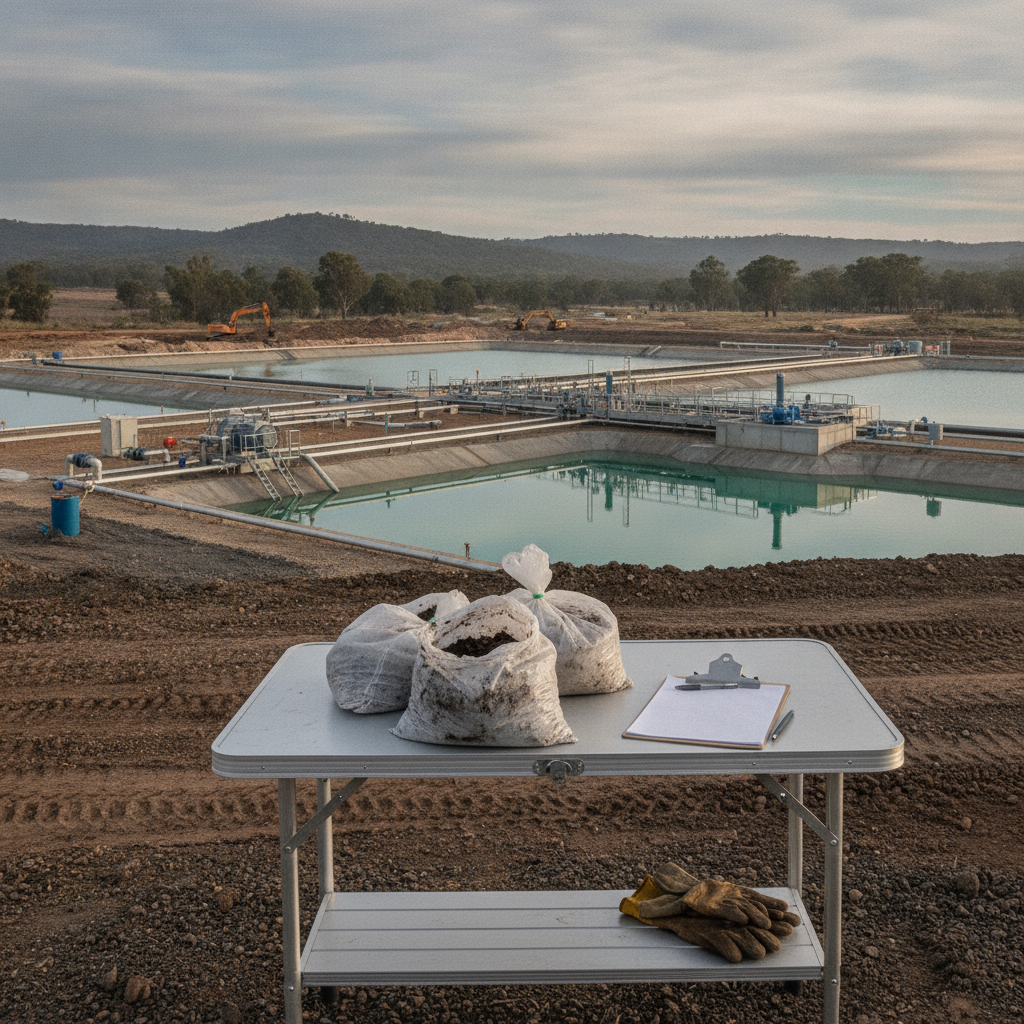
At one of the sites, an operating WWTP within a sensitive coastal catchment, iEnvi excavated 13 test pits and advanced 12 boreholes across the property, collected surface water samples from the treatment lagoon, and commissioned a suitably qualified occupational hygienist to conduct a pre-demolition HBM survey of all site structures. Soil samples were analysed for heavy metals, total recoverable hydrocarbons, BTEX and naphthalene, PFAS, asbestos and acid sulfate soil indicators. Lagoon water was analysed for metals, nutrients, hydrocarbons and PFAS. The wider program also included groundwater monitoring well installation and low-flow sampling to assess shallow aquifer conditions and support dewatering design for the upgrade works.
The investigation was designed in accordance with the National Environment Protection (Assessment of Site Contamination) Measure 1999 (as amended 2013) (ASC NEPM), the PFAS National Environmental Management Plan (PFAS NEMP) Version 3.0 (current at the time of the investigation; now superseded by Version 3.1), and the requirements of the Environmental Protection Act 1994 (Qld). Data quality objectives, field duplicates, rinsate blanks and inter-laboratory splits kept the dataset defensible for incorporation into reference design documentation.
PFAS, Asbestos and Acid Sulfate Soil Findings
The investigation delivered clear, actionable results. Soil quality at the site was generally suitable for continued industrial and utility use, with hydrocarbon concentrations below laboratory limits of reporting and heavy metals within acceptable health and ecological thresholds. That is the good news.
PFAS told a more nuanced story. PFOS was detected in the on-site treatment lagoon at concentrations well above the ANZG 99% species protection freshwater guideline value, confirmed at two separate sampling locations. Any water generated during construction dewatering, lagoon decommissioning or perched-water management will need to be handled under a site-specific PFAS management plan before discharge to the receiving environment. That discipline matters at any plant, and especially at those within sensitive coastal catchments.
The pre-demolition HBM survey identified bonded chrysotile asbestos-containing material in two structures scheduled for demolition, requiring removal by a licensed asbestos removalist under a formal asbestos removal control plan before any works. PCB capacitors in fluorescent light fittings and ozone-depleting substances in air-conditioning equipment also require specialist licensed disposal. One soil sample returned elevated acidity, not from natural acid sulfate soils but from decades of effluent and chemical dosing contact, which raises a corrosivity consideration for new concrete and steel installed at depth.
From Investigation Findings to Construction Management Plans
iEnvi’s reporting gave the council a defensible baseline and scoped the management plans needed before works begin, including a construction environmental management plan (CEMP), a PFAS management plan, an erosion and sediment control plan and an asbestos removal control plan. What could have been an unwelcome mid-construction discovery has instead been identified, characterised and planned for at the design stage, where it is far cheaper and safer to act.
Related Services
Contaminated land advice | Site remediation | Environmental management
Planning a wastewater treatment plant upgrade, or any works program on land with an operational history? Call iEnvi on 1300 043 684 or contact our contaminated land team to scope an investigation before your reference design locks in.
Need advice on this issue? iEnvi provides practical, senior-led environmental consulting across contaminated land, remediation, ecology and environmental risk.
Site remediation Environmental management plans Contaminated land advice Groundwater services Talk to iEnvi