
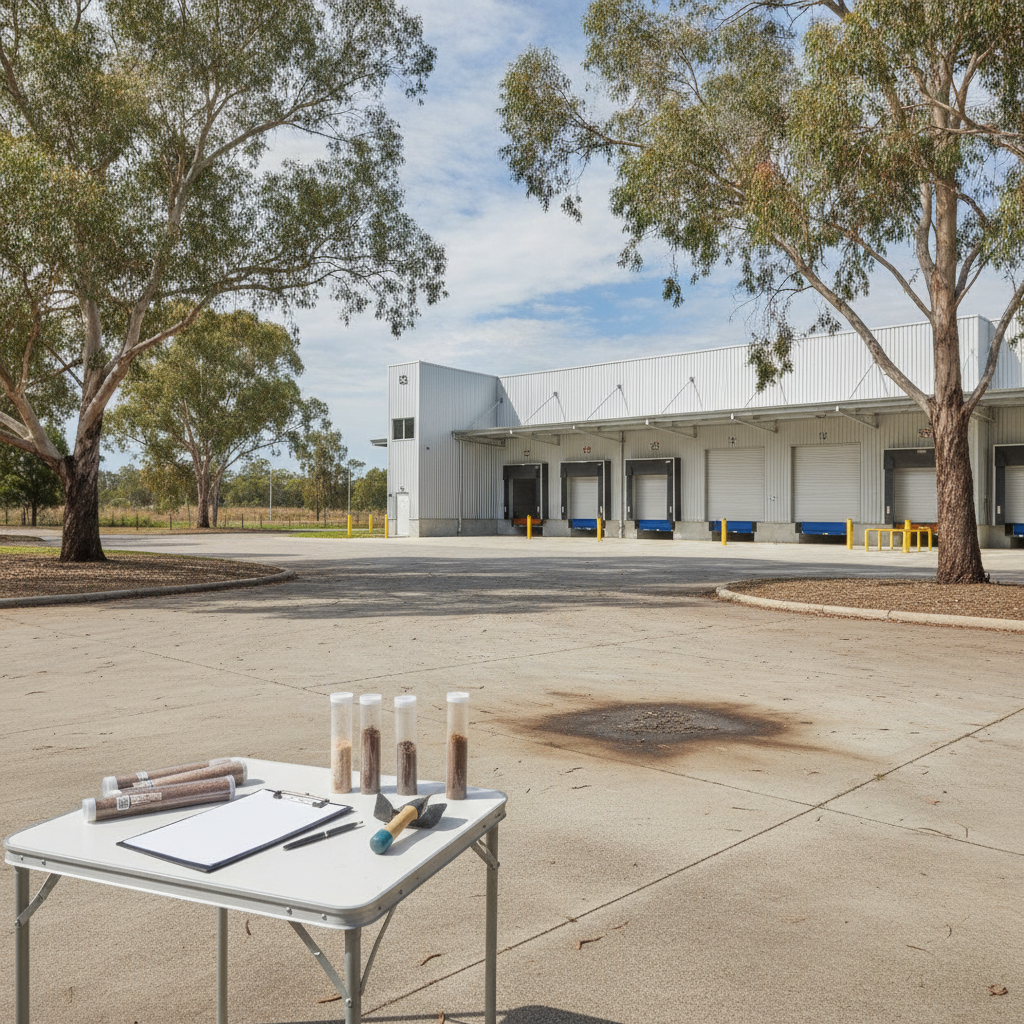
Leasing industrial property can expose a business to contamination costs, even where the contamination existed before the tenancy began.
The consequences extend beyond the clean-up. They can include legal disputes, restricted site access, delayed upgrades and relocation costs.
The tenants who fare best are the ones who can prove what the site looked like on day one. For warehouses, transport depots, workshops and manufacturing facilities, environmental due diligence should form part of the leasing decision.
Why a baseline investigation matters
A baseline environmental investigation records site conditions before occupation. It separates historical contamination from impacts arising during the tenancy.
The difference in practice:
- With a baseline: You hold a dated, independent record of conditions at entry. A claim that your activities caused contamination can be tested against real data.
- Without one: You may struggle to defend that claim at all, especially where successive tenants handled similar substances such as fuels, oils or solvents.
A baseline only protects where it looked. A more detailed investigation does two things a cheaper one cannot:
- It finds more of the contamination that already exists, before you sign.
- It rules out more of the site, leaving fewer untested areas that a later claim can exploit.
A baseline does not remove statutory duties. A tenant may still need to manage risks from historical contamination. It is evidence, not immunity.
One more rule: plan the lease exit investigation to match the baseline in scope, sampling locations and analytical suite. Comparable locations and analytes are what make the before-and-after comparison defensible.
The commercial exposure
Contamination can hit a tenant in several ways:
- Unexpected expenditure: Investigations, monitoring, protective measures and remediation.
- Disputed responsibility: Landlords, tenants and previous operators disagreeing about who caused what.
- Continuing property costs: Rent and lease obligations that run on while site use is restricted.
- Business interruption: Access restrictions cutting production, storage or operating capacity.
- Relocation costs: A new lease, approvals, fitout and equipment moves.
- Lost time: Investigations and remediation can take months or years, with management time diverted to regulators, consultants and lawyers.
These costs can arrive before responsibility is resolved. A baseline changes who they land on:
- With a baseline: Disputes narrow to your actual footprint. Claims settle earlier. Indemnity, insurance and make good discussions start from evidence rather than assertion.
- Without one: You fund investigations first and argue responsibility later, often against parties with better records than you.
What happens if the landlord becomes insolvent
A significant clean-up requirement can exceed the landlord’s financial capacity.
Insolvency does not automatically transfer the landlord’s environmental liability to the tenant. But the tenant’s own statutory obligations still apply.
The practical consequences can include:
- Funding measures required under your own obligations.
- Limited recovery under landlord indemnities.
- Delayed works while funding and responsibility are disputed.
- Restricted operations or relocation.
An indemnity is only useful if it covers the circumstances and the party giving it can pay. A baseline does not make an insolvent landlord solvent, but it changes your position:
- With a baseline: Regulator engagement can focus on the impacts you actually caused, because the inherited contamination is already documented. You also hold dated evidence for any claim in the administration.
- Without one: You are the solvent party on site with no proof of what you did not cause. That is the worst negotiating position in this article.
Key requirements in Queensland, New South Wales and Victoria
The position differs between jurisdictions. Being a tenant does not provide complete protection.
| State | Key duties and powers |
|---|---|
| Queensland | The Environmental Protection Act 1994 is administered by the Department of the Environment, Tourism, Science and Innovation (DETSI). Section 319 (the general environmental duty) requires all reasonable and practicable measures to prevent or minimise environmental harm from activities. Sections 320A and 320DA impose notification duties on occupiers. Qualifying contamination matters require notification within 24 hours. Schedule 3 notifiable activities require notification within 20 business days of becoming aware, or of when the occupier ought reasonably to have become aware. Sections 361, 362 and 367 allow environmental enforcement orders against prescribed persons, including occupiers at the time of a contamination incident. Orders can require investigation, clean-up or cessation of activities. Legislation |
| New South Wales | Section 91 of the Protection of the Environment Operations Act 1997 allows clean-up notices to be issued to occupiers in relevant circumstances. Section 148 requires immediate notification of pollution incidents causing or threatening material environmental harm. Section 60 of the Contaminated Land Management Act 1997 imposes reporting duties on owners and persons whose activities contaminated land, where statutory triggers apply. It is not a blanket reporting duty on every tenant. Clean-up powers, incident notification, contamination reporting |
| Victoria | Section 39 of the Environment Protection Act 2017 requires persons managing or controlling contaminated land to minimise risks, so far as reasonably practicable. This applies even where they did not cause the contamination. Section 40 requires notification of notifiable contamination as soon as practicable after the person becomes aware of it. The Environment Protection Regulations 2021 prescribe which contamination is notifiable and the exceptions. Management duty, notification requirements |
Additional requirements apply to particular infrastructure. In NSW, the Protection of the Environment Operations (Underground Petroleum Storage Systems) Regulation 2019 requires those managing or controlling underground fuel systems to maintain leak detection and management arrangements. EPA guidance
Eight common scenarios for industrial tenants
The duties above matter most when something forces them to the surface. Eight situations account for most tenant disputes on industrial sites.
In each, three questions decide the outcome: what does the law say, who is still solvent, and what evidence exists. The last column shows how a day-one baseline changes the answer to the third.
| Scenario | Queensland | New South Wales | Victoria | Indicative allowance | Impact on the tenant |
|---|---|---|---|---|---|
| 1. New owner buys in, finds hidden liability, and alleges the current tenant caused part of it | A private dispute first. If a notifiable activity or contamination is identified, notification duties under sections 320A and 320DA apply, with register listing to follow. Enforcement orders under sections 361, 362 and 367 can reach an occupier at the time of an incident. | Largely contractual until the EPA engages. A section 91 clean-up notice can be issued to an occupier. Section 60 reporting duties sit with owners and those whose activities contaminated the land. | The section 39 duty applies to you as the person in management or control, whatever the new owner alleges. Section 40 notification runs separately. | Investigation to define your footprint $15,000 to $60,000. Legal and expert evidence $20,000 to $100,000+. | With a baseline: your dated dataset caps the allegation at your actual footprint, and claims tend to settle early. Without one: renegotiation pressure and make good claims are hard to rebut, and management time balloons. Operations usually continue either way. |
| 2. Regulator begins acting on the site, the landlord fails, and you are the solvent operator | Sections 361, 362 and 367 allow enforcement orders against prescribed persons, including occupiers. Where the owner no longer exists, the occupier becomes the realistic recipient. | Section 91 clean-up notices are expressly available against occupiers. Under the Contaminated Land Management Act, management orders follow the person responsible for the contamination, then the owner. An innocent tenant is not usually the first target under that Act, but section 91 notices to the occupier become the practical route once the owner cannot pay. | Section 39 already places the duty on the person in management or control. The landlord’s failure does not change your position. The most direct tenant exposure of the three states. | Investigation $30,000 to $150,000. Remediation is the variable and is commonly six figures. Recovery against a failed landlord is usually nil. | The most severe path. A baseline cannot remove occupier duties or replace the landlord’s funding. It can confine any order or works to impacts you actually caused, because the rest is documented as inherited. Without one: you may fund site-wide investigation with nil recovery while rent continues. |
| 3. A spill during your occupancy commingles with historical contamination and cannot be apportioned | Qualifying contamination requires notification within 24 hours. Section 319 requires reasonably practicable measures. Delineation must separate your release from the pre-existing plume. | Section 148 requires immediate notification where material environmental harm is caused or threatened. A section 91 clean-up notice can follow quickly. | Section 40 requires notification as soon as practicable, alongside the continuing section 39 management duty. | Response and investigation $25,000 to $120,000. Forensic apportionment (fingerprinting, age dating, isotope analysis) adds $15,000 to $60,000 and often gives no clean answer. | With a baseline: the pre-existing plume is already documented, so you fund only your own release. Without one: apportionment rests on expensive forensics that often fail, and you risk funding the whole plume. |
| 4. Owner becomes insolvent or dies, the land is sold or acquired, and your share is disputed | Register particulars drive the sale process. With no solvent owner, you may be the only party able to fund investigation. | Identifying the appropriate person is contested between the estate or liquidator, the incoming owner and you. Section 60 duties continue for owners and those whose activities contaminated the land. | Section 39 continues to apply while you remain in management or control, including through a sale process. | Investigation $30,000 to $100,000. Legal and expert witness costs $50,000 to $250,000+ where apportionment is litigated. | With a baseline: your share is anchored to a dated dataset and litigation narrows. Without one: apportionment becomes expert reconstruction, costs escalate, and tenure and capital works planning stall while relocation risk grows. |
| 5. Lease exit and make good, with no day-one baseline | Primarily a lease dispute. Your own exit investigation can identify a notifiable activity or contamination and trigger sections 320A and 320DA, with register listing to follow. | Largely contractual until a statutory trigger is met. An exit investigation that reveals contamination can trigger section 60 duties for the owner, and for you if your activities caused it. | Section 39 continues through the make good period. Section 40 applies if notifiable contamination is found. | Exit condition assessment $8,000 to $30,000. Disputed make good claims add legal costs of $15,000 to $80,000. Remediation to satisfy make good is separate and variable. | This is the no-baseline case in full. With a baseline: exit is a like-for-like comparison and the bond is usually released. Without one: the claim lands after you have relocated and lost site access, and is hard to rebut. Bond withheld, holding-over rent, legal costs. |
| 6. Your own works disturb contaminated fill | Disturbance engages the section 319 duty. Identifying contamination or a notifiable activity engages sections 320A and 320DA. Soil leaving the site needs classification, a disposal permit where the land is on the Environmental Management Register or Contaminated Land Register, and the waste levy within the levy zone. | Soil leaving the site must be classified under the EPA waste classification framework, with the waste levy applying in the regulated area. Sections 148 and 60 apply if triggered. | The section 39 duty applies to the disturbance, with section 40 notification if notifiable contamination is found. Soil leaving the site carries its own duties under the Act. | Classification and validation $10,000 to $40,000. Disposal commonly runs $150 to $500 per tonne, higher for hazardous classifications, so a modest excavation can exceed $100,000 in disposal alone. | A baseline does not avoid classification or disposal costs; those follow your works. It does prove the fill pre-dated you, which supports a landlord contribution and defeats any claim that you imported it. Without that evidence: works stop, the full cost falls on you, and it is rarely recoverable. |
| 7. A plume from an offsite source migrates under your site | You are not the source, but once aware of contamination the occupier notification duty in section 320DA can still apply to you. | The upgradient source is the logical target, but a section 91 clean-up notice can still be issued to an occupier in relevant circumstances. Section 148 applies to incidents from your own premises. | Section 39 applies to you as the person in management or control even though you did not cause the contamination. Being the receptor is not a defence. | Vapour and groundwater assessment $20,000 to $70,000. Vapour mitigation such as sub-slab depressurisation or sealing $30,000 to $150,000. Recovery against the offsite source is a separate legal exercise. | With baseline groundwater data: you can show the plume came from offsite and pre-dated or bypassed your operations, which supports recovery and narrows your role to managing risk. Without it: you fund interim mitigation while causation is argued, with worker exposure and WHS questions inside the building. |
| 8. You inherit an undocumented or non-compliant fuel system | Petroleum product or oil storage above Schedule 3 thresholds is a notifiable activity, with register listing risk. Section 319 applies to your operation of the system. | The Underground Petroleum Storage Systems Regulation 2019 places leak detection, monitoring and planning duties on the person with management or control, commonly the operating tenant. Non-compliance is enforceable directly against you. | The section 39 duty and the general environmental duty apply to your operation of the system, with section 40 notification if notifiable contamination is found. | Integrity assessment and compliance gap review $10,000 to $35,000. Retrofitting leak detection $25,000 to $120,000. Removal and validation where the system has failed $80,000 to $300,000+. | Compliance duties attach to you as operator whether or not a baseline exists. A pre-lease investigation still protects you: it finds the system before you sign, prices the retrofit or the walk-away, and samples around the tanks so old leaks are not attributed to your operation. Without it: you discover the system mid-lease and fund compliance blind, with fuel operations possibly ceasing until compliant. |
These allowances are indicative planning figures for a modest-sized industrial site. Unlike the investigation allowances later in this article, they include legal and expert costs. They exclude GST and statutory audits, and exclude remediation unless a remediation item is listed in the row.
The common thread is evidence:
- Scenarios 1, 3, 4, 5 and 7 are apportionment fights. With a baseline, apportionment is argued from a dated pre-occupation dataset. Without one, it is argued through forensic reconstruction years later, at far higher cost and with worse odds.
- Scenarios 2, 6 and 8 are different. The Victorian management duty, the Queensland and NSW occupier powers and the NSW fuel system duties can attach to you regardless of who caused the contamination. A baseline will not remove those duties or make an insolvent landlord pay. It still narrows what you can be asked to investigate, supports recovery where a solvent party exists, and stops historical impacts being counted as yours. Those scenarios remain solvency, lease structure and compliance problems, and a baseline will not solve them on its own.
Recent enforcement examples
- Victorian petrol station tenant, October 2025: EPA reported penalties against a Collingwood tenant company and its director for failing to comply with notices. Requirements included groundwater and vapour sampling, reporting and tank integrity information. The investigation identified current and historical contamination potentially moving offsite. Tenants can face direct investigation requirements and enforcement. A day-one baseline would not have avoided the notices, but it would have separated the historical component from anything attributable to the tenant’s operation. Without one, the tenant carries the whole question. EPA case
- Former Truegain site, NSW, June 2025: The former owner and director received $200,000 in fines and $201,487 in investigation and legal costs for notice breaches. The government acquired the property from its bankrupt former owner, with remediation continuing into 2026. This shows the financial and time consequences of unresolved contamination. It does not establish that an innocent tenant inherits an owner’s liability. But for any tenant on a site like this, baseline evidence is what separates its own footprint from decades of prior operation once regulators and administrators start allocating costs. EPA announcement, remediation history
When the risks increase
Further assessment is particularly important where:
- Previous uses involved fuel storage, vehicle maintenance, manufacturing or waste handling.
- The site contains underground tanks, stained ground or undocumented fill.
- Firefighting foam may have been used or stored, or fire events or fire system testing have occurred. These can leave PFAS, which should be assessed in line with the PFAS National Environmental Management Plan (PFAS NEMP) 3.1.
- Historical reports identify contamination or ongoing monitoring requirements.
- Proposed works will disturb soil or groundwater.
- The landlord cannot provide reliable environmental records.
- A property sale, lease expiry or unrelated regulatory investigation could trigger further scrutiny.
A site’s absence from a public contamination register is not confirmation that it is uncontaminated.
Choosing a proportionate investigation
Each tier of spend buys two things: a better chance of finding contamination that already exists, and fewer untested areas left as data gaps. More coverage before signing means a stronger with-baseline position in every scenario above.
| Approach | Typical scope | Preliminary allowance |
|---|---|---|
| Bare-bones screening | Historical review, register searches, inspection, photographs and existing records. Does not establish subsurface conditions. | $3,000 to $8,000 |
| Targeted baseline | Screening plus soil sampling and groundwater assessment where warranted. Focuses on identified contamination risks. | $15,000 to $35,000 |
| Comprehensive baseline | Full investigation of relevant soil, groundwater and vapour risks. Independent review where warranted. Agreed management and exit assessment requirements. | $40,000 to $100,000+ |
What the spend buys in protection:
- No investigation: Every scenario in the table runs on its without-baseline path. You argue from reconstruction, not records.
- Bare-bones screening: Identifies risk and flags red lines before signing, but proves nothing about the subsurface. The whole subsurface remains a data gap that a later claim can exploit.
- Targeted baseline: Puts real soil and groundwater data behind the identified risk areas. You are well protected where you sampled. Untested areas remain arguable.
- Comprehensive baseline: Covers soil, groundwater and vapour, so it finds the most existing contamination and rules out the most ground. Fewest gaps, strongest exit comparison. On long leases or high-risk sites, the extra spend is small against the six-figure exposures in the scenario table.
Baseline and exit investigations should be designed and reported in line with the National Environment Protection (Assessment of Site Contamination) Measure 1999, as amended in 2013 (NEPM ASC 2013), together with the relevant state guidance. In NSW, that includes the NSW EPA Sampling Design Guidelines 2022.
Scope the exit investigation to match the baseline. Match size and depth of coverage, reuse the same or similar sampling locations, and run the same or similar analytical suite. The protection lies in a like-for-like comparison. A thin exit after a detailed baseline, a detailed exit after screening only, or an exit that samples different spots or different analytes, leaves gaps that both sides can argue over. Agree the exit scope, locations and suite in the lease at the same time as the baseline.
These are indicative budgeting allowances for a modest-sized industrial site, not quotations. They exclude GST, legal fees, remediation and statutory audits. Site size, access, drilling requirements and analytical scope can materially change the cost.
Practical steps before signing
- Obtain previous investigations, notices and remediation records.
- Complete environmental screening before committing to the lease.
- Investigate identified risks before occupation, at a scope proportionate to the lease term and site history.
- Have both parties acknowledge the baseline findings in writing.
- Agree in the lease that the exit assessment will mirror the baseline in scope, sampling locations and analytical suite (same or similar contaminants and methods).
- Obtain legal advice on historical contamination and make good obligations.
- Assess the landlord’s financial capacity.
- Consider financial security for identified liabilities.
- Negotiate access, rent relief and termination provisions.
Environmental evidence and lease provisions work together. An indemnity without a baseline has nothing to measure against; a baseline without lease provisions has no mechanism to enforce. Neither substitutes for the other.
How iEnvi helps
iEnvi delivers the technical stages industrial tenants and their advisers need before and during a lease:
- Preliminary site investigations (PSI) for pre-lease screening and baseline scoping
- Detailed site investigations (DSI) where screening identifies subsurface risk
- UPSS and fuel storage investigation, removal and validation
- Human health and ecological risk assessment
- Remediation, RAP and validation where works are required
- Baseline and matching exit condition reporting, with CEnvP Site Contamination Specialist direction
Considering an industrial lease? Call 0411 492 159 or contact iEnvi with the address, proposed use and any environmental records the landlord has provided. We will tell you whether screening, a targeted baseline or a fuller investigation is the realistic next step before you sign.
This article provides general information for industrial tenants in Queensland, NSW and Victoria. Requirements depend on the site, activities and lease. Legislative references were checked in September 2026.
Need advice on this issue? iEnvi provides practical, senior-led environmental consulting across contaminated land, remediation, ecology and environmental risk.
PSI services DSI services UPSS investigation and validation Team credentials Talk to iEnvi