
What do lenders and insurers require for environmental due diligence in an Australian deal?
Requirements vary by lender and insurer, but where a site’s history suggests contamination risk, lenders commonly ask for a Phase 1 and, if it identifies a credible risk, a Phase 2. They usually want the work prepared by a suitably qualified consultant who will allow the lender to rely on the report, and facility documents often include environmental conditions precedent and an environmental indemnity. Insurers of pollution or environmental impairment risk want enough site information to price and define the cover, and they generally do not cover known contamination unless it is disclosed and accepted on specific terms. Warranty and indemnity (W&I) policies generally exclude known issues and commonly exclude or limit contamination. One investigation scoped to meet the buyer, lender and insurer at once avoids duplicate reports and delay, and gives the buyer a documented basis to negotiate price.
Many deals reach the environmental stage with a surprise. The buyer has commissioned a report, then the bank says it wants its own, or the insurer says the report does not give it enough to quote. Weeks go by, a second consultant is engaged and the timetable slips. Most of that can be avoided if you understand the lender environmental due diligence requirements, and what the insurer will ask, before anyone is engaged.
This is the eleventh article in our series on environmental due diligence (EDD) for M&A in Australia. Earlier articles covered why environmental due diligence matters in Australian M&A, Phase 1 vs Phase 2 environmental assessments, negotiating price, warranties, indemnities and escrow, vendor environmental due diligence, PFAS liabilities in transactions, contaminated land registers and notices by state, UPSS due diligence, asbestos and hazardous building materials, environmental licences and compliance history and pricing contamination risk. This one covers what financiers and insurers ask for, and how to scope your investigation so it satisfies them the first time.
Why lenders care about contamination
A lender’s main interest is its security. If a property is contaminated, its value as security can fall and it can be harder and slower to sell. Contaminated land laws in each state and territory allow regulators, in some circumstances, to require investigation or clean-up by the polluter and, in some cases, by an owner or occupier. A lender that takes possession or appoints a receiver may also want to understand whether that step brings any exposure. Because the rules differ between jurisdictions, lenders generally look for advice that suits the state or territory concerned.
For an operating business, the lender also looks at the borrower’s cash flow. A large clean-up or a licence problem can strain the ability to repay, even where the land is not the main security. That is why environmental questions show up in both property finance and acquisition finance.
Lender environmental due diligence requirements: when a Phase 1 or Phase 2 is needed
There is no single national rule, and each lender sets its own credit policy. As a general pattern, lenders tend to ask for a Phase 1 environmental site assessment where the land has an industrial or commercial history, where it makes up a significant part of the security, or where the loan is large. A Phase 2, meaning intrusive sampling, is usually requested where the Phase 1 identifies a potential source and pathway, for example fuel storage, solvents, fill of unknown origin or PFAS-related activity. Lenders may also expect the report to be recent, so an older report may need updating.
Lenders commonly ask for these at particular points:
- Before credit approval, so the credit team can understand the risk and set any conditions.
- As a condition precedent to drawdown, where the report is still being finalised when terms are agreed.
- On a refinance or extension, particularly if the use of the site has changed or new information has emerged.
- Before enforcement or sale of security, to understand what a purchaser will find.
Where a site is already known to be impacted, a lender may ask for a detailed site investigation, a remediation action plan or, in some cases, an audit by an accredited site auditor under the relevant state or territory scheme. Whether an audit is needed depends on the site, the regulator and the deal, so confirm it early.
Reliance letters and consultant requirements
The most common source of duplicate work is reliance. A consultant’s report is written for the client who engaged them. A lender is not that client, so it cannot assume it may rely on the findings. Lenders typically ask either to be named as an addressee or for a reliance letter confirming the lender can rely on the report. Reliance is usually given on the same terms as the original engagement, and the liability cap is often shared with the client rather than added to it. Lenders may also ask for reliance to extend to a security trustee, other syndicate members or a later assignee, which the consultant may or may not accept.
Raise this at the start. If the engagement terms do not allow third party reliance, they may need to be amended, and some consultants will want to see the lender’s proposed wording first. Fixing it after the report is issued adds time when there is least of it.
Lenders and insurers also tend to look at who prepared the work. Common expectations include:
- Qualifications and experience. Evidence the work was done or reviewed by a suitably experienced contaminated land professional, for example a Certified Environmental Practitioner Site Contamination Specialist (CEnvP SC) or an equivalent recognised certification. Some state regulators now also expect certain contamination reports to be prepared or reviewed by a certified practitioner.
- Professional indemnity insurance. Many lenders specify a minimum level of cover and ask for a certificate of currency. The level is the lender’s decision, so check its requirements early. PI cover is usually written on a claims made basis, so a lender may also ask that it be maintained for a period after the report.
- Independence. The consultant should be engaged on a proper scope, not asked to reach a preferred answer.
- Method. Reporting that follows recognised guidance such as the National Environment Protection (Assessment of Site Contamination) Measure (ASC NEPM) and relevant state guidelines.
You can see our team credentials if you need to show a lender or insurer who is doing the work.
Conditions precedent, covenants and environmental indemnities
Environmental terms in finance documents vary between lenders and deals, but they often include the following:
- Conditions precedent. Delivery of an environmental report, with reliance, in a form satisfactory to the lender before funds are released. Some lenders also require evidence that recommended works have been completed or funded.
- Representations and undertakings. The borrower confirms it complies with environmental law and holds the approvals it needs, and promises to tell the lender about notices, incidents or investigations.
- Information and access rights. The lender may be able to commission its own assessment in defined circumstances, often at the borrower’s cost.
- Environmental indemnity. The borrower, and sometimes guarantors, agrees to cover the lender for loss arising from contamination or environmental liability connected with the secured property. These indemnities are often expressed to survive repayment.
- Events of default. A serious unresolved environmental issue, or failure to meet an environmental undertaking, may trigger default rights.
An environmental indemnity is a promise to pay, and it is only as strong as the party giving it and the information behind it. A borrower who signs one without understanding the site may take on a liability that is open ended in practice. The drafting is a legal matter for your lawyer, but the technical position helps. A clear baseline report records the condition of the site at the start, which can matter if there is a later dispute about what changed and when.
Security valuation: how findings flow through to the lender
Many valuation reports state that the valuer is not a contamination expert and assume the land is unaffected unless told otherwise. That is one reason lenders ask for a separate environmental report. Where a report does show contamination, a valuer may reduce the value, make an allowance for cost and stigma, or value on the assumption that the issue is resolved, depending on the instructions. The lender then applies its loan-to-value limits to that figure, so a finding can affect how much the lender will advance, not just whether it will lend.
This is where the quality of the estimate counts. A vague note that “contamination may be present” can lead to a heavy discount. A defined scope, a costed range and a clear management plan give the valuer and credit team something concrete to work with. In practice, the more clearly the problem is bounded, the less conservative the lender usually needs to be.
What environmental and transaction insurers require
Insurance can help allocate environmental risk, but it is not a substitute for investigation. Two products come up most often in deals, and they work very differently.
Pollution legal liability and environmental impairment cover
Environmental impairment liability (EIL) or pollution legal liability (PLL) policies are designed to respond to pollution conditions. Terms vary a great deal between insurers, but underwriting usually starts with information: site history, operations, existing reports and any regulatory history. For a transaction, insurers commonly want to see the Phase 1 and any Phase 2 results.
The key point is how these policies treat known contamination. As a general rule, a policy does not respond to contamination the insured knew about and did not disclose. Where contamination is known and disclosed, the insurer may exclude it, limit cover for it or accept it on specific terms, and it will usually want the issue assessed and described before deciding. Other common limits include retroactive dates, restrictions on gradual pollution, and exclusions or endorsements for asbestos or PFAS. Insureds also have a duty of disclosure under the Insurance Contracts Act 1984 (Cth), so what you know matters.
In practice, a thorough investigation does more than support your negotiation. It can influence whether cover is offered, what it excludes and what it costs.
W&I insurance and known conditions
Warranty and indemnity insurance covers loss from breaches of the seller’s warranties in the sale agreement, and is aimed at matters that were not known. Policies generally exclude issues known to the buyer’s deal team, including matters disclosed or identified in due diligence. Many policies also exclude environmental or contamination matters, or cover them only on limited terms, and the position varies by insurer and the type of target.
The consequence is simple. If your EDD finds contamination, a W&I policy will usually not pick it up. The risk then has to be handled another way: a price adjustment, a specific indemnity, a retention, a remediation covenant, or a separate environmental policy where one is available. Our article on negotiating price, warranties, indemnities and escrow explains how those tools work.
Nor should buyers assume W&I replaces environmental diligence. Insurers usually ask what environmental diligence was done and what it found, and where it was limited they may exclude or narrow cover for environmental warranties.
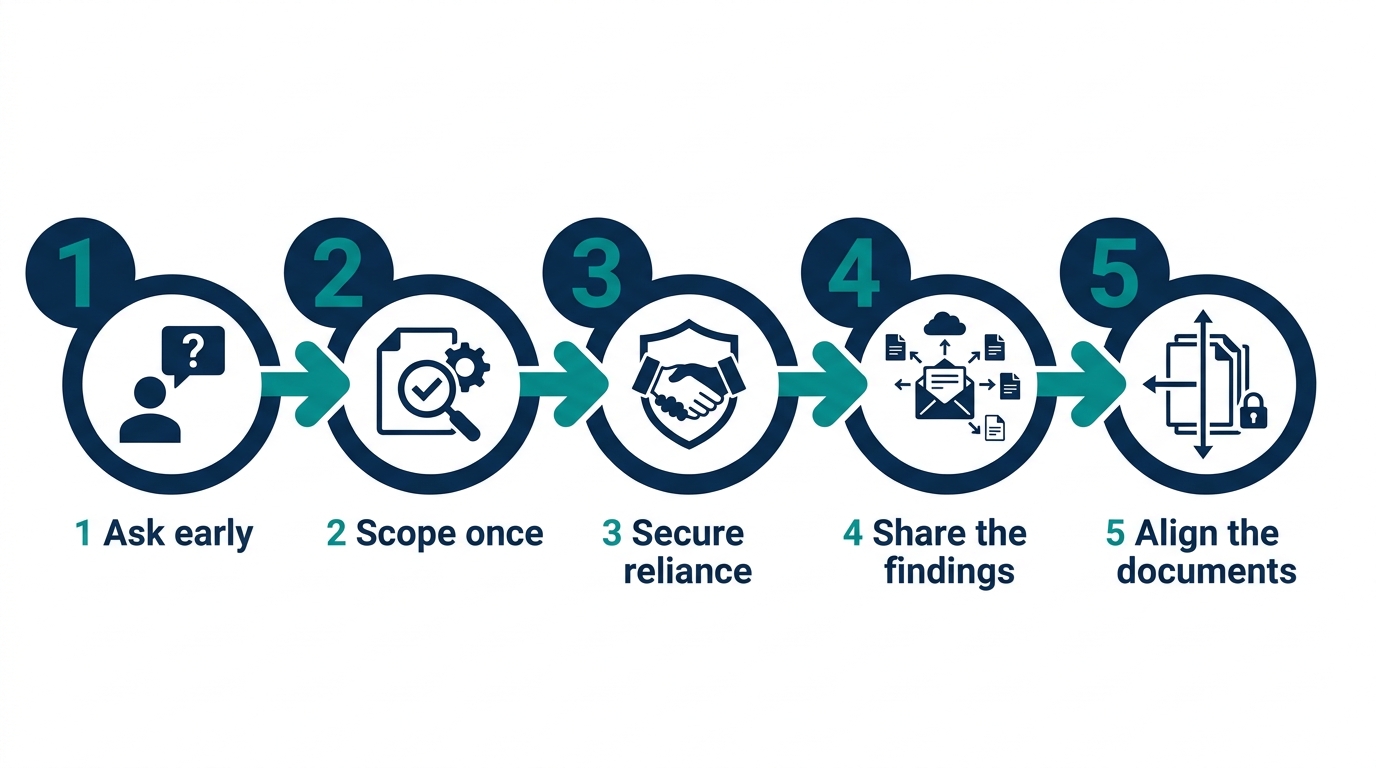
A five-step approach to meeting lender and insurer needs
- Ask early. Get the lender’s environmental requirements, any standard reliance wording and the insurer’s information list before engaging a consultant.
- Scope once. Agree one scope that covers the buyer’s questions and the lender’s and insurer’s minimum content, including the guidelines to be followed and the level of detail needed.
- Secure reliance. Build reliance and addressee wording into the engagement, and confirm consultant qualifications and insurance certificates.
- Share the findings. With your lawyer’s input on confidentiality, give the report and a short plain summary to the lender, valuer and insurer together so their questions come in one round.
- Align the documents. Make sure the finance documents, sale agreement and insurance terms treat the same findings in the same way.
A hypothetical example
The following example is hypothetical and is not based on any client or project.
A buyer is acquiring a business that operates from a leased industrial site in regional Australia, funding part of the price with a bank loan. The buyer’s Phase 1 identifies a former fuel storage area. The bank says it wants its own report. An environmental insurer, approached about a policy, asks for sampling results.
If the buyer deals with each request in turn, a second desktop report is commissioned for the bank, the insurer’s sampling request follows, and the timetable moves back by weeks. If the buyer instead shares the bank’s requirements and the insurer’s information list with its consultant, the bank can be given reliance on the existing Phase 1, and a single targeted Phase 2, with the landlord’s consent to sample, can answer all three parties. Everyone then responds to the same facts.
If the finding is minor, the lender may simply note it. If it is more significant, the buyer has real figures to use in price talks and to weigh against its make-good obligations under the lease, and the insurer can say what it will and will not accept. Either way, the buyer is not guessing.
How this reduces risk and supports price
Meeting lender and insurer needs is partly a cost of doing the deal, but it also pays back in three ways.
- Fewer delays. A single scope avoids a second report, repeated queries and conditions that surface late.
- Better terms. A lender who can see the issue is bounded may accept it with conditions rather than reduce its advance. An insurer who can see the data may quote with a narrower exclusion.
- Negotiating leverage. A credible technical record gives a buyer a basis to ask for a price adjustment, retention or indemnity, instead of a general claim that the site “might be contaminated”.
Sellers should think about this early too. A buyer’s lender will ask the same questions of the sale site. A seller who holds a recent report, prepared on terms that allow reliance by the buyer and its financier, can avoid a gap in the process and protect the price by showing what is not a problem and what has already been priced. That makes a price chip based on fear rather than data much harder to justify.
Common mistakes
- Commissioning the report first and asking the lender later. The scope, guidelines or reliance terms may not meet its needs.
- Assuming W&I insurance covers contamination. Known issues are generally excluded, and environmental matters are commonly excluded or limited.
- Hiding or downplaying a finding. The duty of disclosure applies to insurance, and misstatements can put both cover and finance at risk.
- Signing an environmental indemnity without understanding the baseline. Get legal advice, and know the condition of the site first.
- Treating the lender, valuer and insurer separately. They often ask related questions, and the answers need to match.
- Leaving it until the end. Phase 2 fieldwork, laboratory turnaround, access consents and reliance letters all take time, so start before the timetable is tight.
Why iEnvi specialises in lender and insurer requirements for transactions
Environmental due diligence for a deal is different from routine consulting. The report has several readers, the timetable is fixed and the findings must hold up when a bank, an insurer or the other side tests them. iEnvironmental Australia focuses on contaminated land, groundwater, remediation and waste work, including pre-purchase due diligence with limited soil investigation and waste classification. We scope work to the deal, write reports that can carry reliance where our terms allow, and explain findings in terms a credit team, valuer or underwriter can use. We do not provide legal, financial, lending or insurance advice, and we work alongside your lawyers, brokers and lenders.
Talk to iEnvi about environmental due diligence for your deal
If you are buying, selling or financing a site and a lender or insurer has asked for environmental information, talk to us before you commission anything. We can review what they need, scope one investigation to suit, and help get the reliance and reporting terms right from the start. Send us a message through our contact page.
This article is general information only and is not legal, financial, insurance or accounting advice. Lender policies, insurance terms and environmental requirements differ between organisations, states and territories and change over time, so get advice that suits your deal and sites.
References
- National Environment Protection (Assessment of Site Contamination) Measure 1999, as amended 2013 (ASC NEPM).
- Insurance Contracts Act 1984 (Cth), duty of disclosure.
- State and territory contaminated land legislation and guidelines, which differ by jurisdiction.
- Law firm and insurer publications on W&I insurance exclusions and environmental impairment liability insurance in Australia (general market practice).
Need advice on this issue? iEnvi provides practical, senior-led environmental consulting across contaminated land, remediation, ecology and environmental risk.
DSI services UPSS investigation and validation Team credentials Contaminated land advice Talk to iEnvi