
Overview
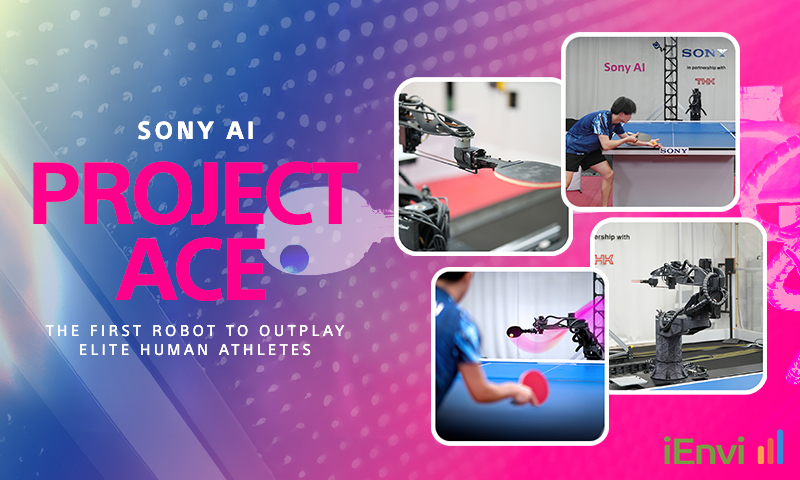
On 22 April 2026, Sony AI published a landmark study in the journal Nature announcing that its “Project Ace” robotic system had achieved human expert-level performance in competitive table tennis. This is the first time a physical robot has demonstrated the capacity to compete against elite human players in a high-speed, adversarial sport requiring continuous real-time adaptation. The research represents a decisive step forward in what the field now refers to as physical AI: autonomous, embodied systems that interact with the unpredictable physical world rather than operating in the constrained digital or simulation environments that define large language models and earlier AI generations.
The significance of this development extends well beyond sport. For professionals working in industries where automation must contend with dynamic, unstructured environments, including manufacturing, logistics, environmental monitoring, and hazardous site operations, Project Ace establishes a new benchmark for what robotic systems can realistically achieve. The system does not follow a pre-programmed sequence of movements. It perceives, reasons, and responds in real time to an opponent whose behaviour it cannot fully predict. That capability profile is categorically different from the industrial robots that have characterised automation for the past four decades.
For environmental practitioners, site owners, developers, and the lawyers and councils who advise them, the relevance of this development is practical and near-term. Autonomous robotic systems capable of operating in unstructured field environments are moving from research demonstration to commercial deployment. The regulatory and operational frameworks that govern environmental site work in Australia were not designed with agentic robotics in mind, and the gap between technological capability and regulatory readiness is narrowing quickly.
Key details
The Project Ace system, as described in the 22 April 2026 Nature publication, achieves performance at the level of a human expert in table tennis, a sport that demands reaction times measured in milliseconds and the ability to interpret complex ball trajectories influenced by high-speed spin, bounce variation, and opponent positioning. The robot must perceive the incoming ball, calculate its trajectory, determine an appropriate return strategy, and execute a precise physical response, all within timeframes that approach the physiological limits of human reaction time. This is not a controlled or simplified version of the task. The system competes against real human players under standard competitive conditions.
The technical architecture underpinning this capability combines three integrated elements. The first is high-performance sensor fusion, which allows the robot to perceive its environment with sufficient speed and resolution to track a small, fast-moving object and interpret spin characteristics in real time. The second is reinforcement learning, the training methodology through which the system develops its decision-making and movement strategies by iterating through vast numbers of competitive interactions, refining its responses based on outcomes rather than following explicit programmatic rules. The third is precision hardware that can translate the system’s decisions into physical actions with the speed and accuracy required to compete effectively. The integration of all three elements at the performance level demonstrated by Project Ace is what makes this publication a genuine threshold event.
The adversarial nature of the task is a critical technical distinction. Industrial robots have historically operated in environments engineered for predictability: parts arrive in known positions, movements follow fixed paths, and the system does not need to respond to an agent actively working to defeat its strategy. The Project Ace system operates against a human opponent who adapts, varies technique, and attempts to exploit the robot’s weaknesses. The robot must adapt in return. This adversarial dynamic is much closer to the conditions encountered in real-world field operations than anything a conventional industrial robot is designed to manage.
The publication in Nature is significant not only for its findings but for the peer-review standard it represents. Research published in Nature undergoes rigorous independent scrutiny, and the acceptance of this work confirms that the performance claims are methodologically sound and reproducible. The Sony AI announcement explicitly frames the project as a contribution to the broader field of real-world artificial intelligence and robotics, indicating that the underlying technologies are intended for application well beyond the specific demonstration domain of table tennis.

Australian context and implications for professional services
Australia does not yet have a regulatory framework specifically designed for the deployment of autonomous physical AI systems in environmental or industrial field settings. However, the existing frameworks that govern site assessment and contamination management in Australia will inevitably apply to robotic systems deployed in those contexts. The National Environment Protection (Assessment of Site Contamination) Measure 2013, commonly referred to as NEPM 2013, sets out the requirements for site characterisation, sampling methodology, quality assurance, and reporting in contaminated land assessment. Ground-based robotic systems deployed for soil sampling, subsurface investigation, or site monitoring would need to demonstrate compliance with the sampling and data quality requirements under NEPM 2013, regardless of whether the operator is a human technician or an autonomous system. The question of how to validate and document the performance of an agentic system within a NEPM 2013-compliant quality assurance framework is one that environmental practitioners and regulators will need to resolve as these systems move toward field deployment.
References and related sources
- Primary source: ai.sony
- ienvi.com.au
- https://ai.sony/blog/sony-ai-announces-breakthrough-research-in-real-world-artif
- NEPM Assessment of Site Contamination
How iEnvi can help
iEnvi integrates technology and data-driven approaches into environmental consulting. We monitor AI and technology developments that affect how environmental professionals deliver services to clients.
This is an iEnvi Machete news summary. Prepared by iEnvi to summarise the source article for contaminated land, groundwater, remediation, approvals and site risk professionals.
Published: 24 Apr 2026
Need advice on this topic? Speak to an iEnvi expert at hello@ienvi.com.au or 1300 043 684, or contact us online.
Need advice on this issue? iEnvi provides practical, senior-led environmental consulting across contaminated land, remediation, ecology and environmental risk.
Contaminated land services Remediation services Groundwater services Talk to iEnvi