
How is asbestos in soil assessed in Australia?
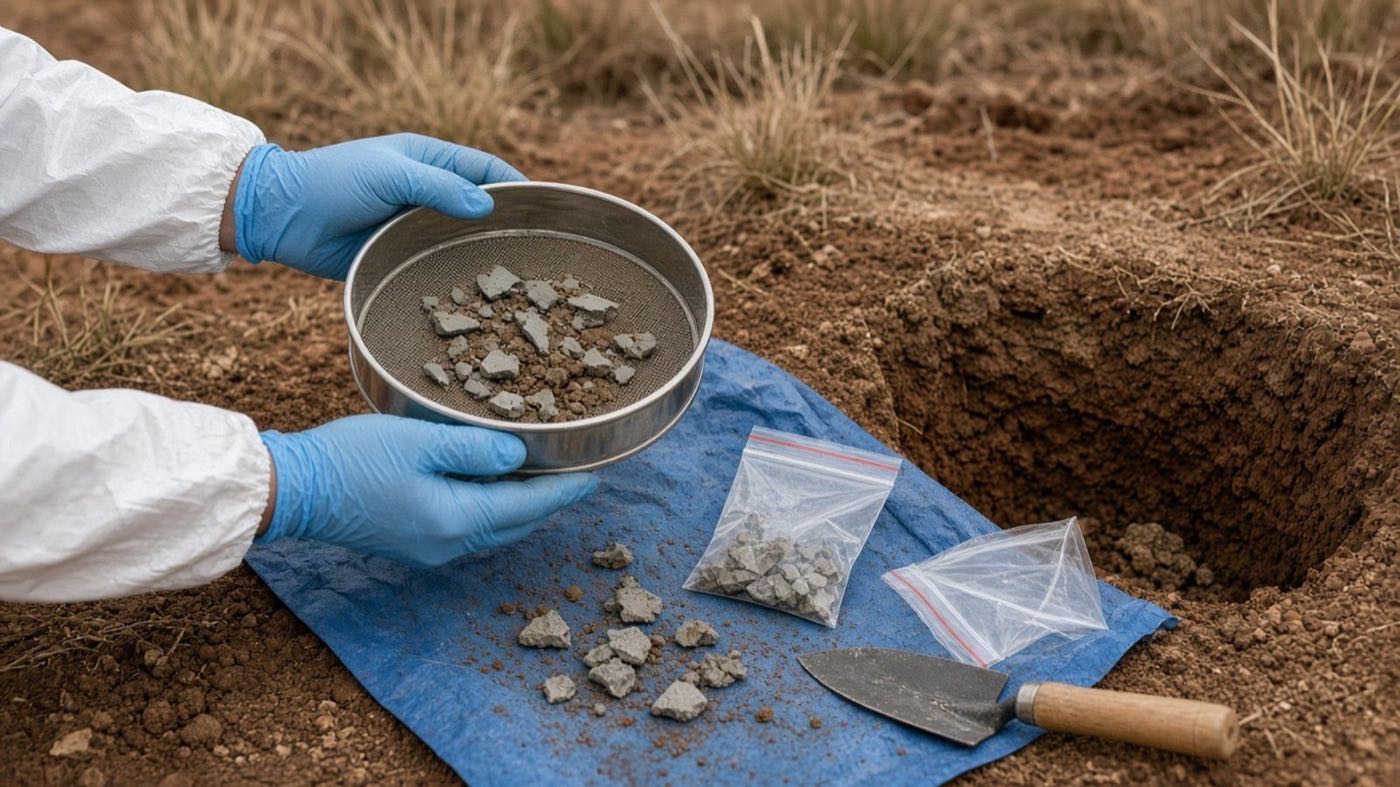
Asbestos in soil is assessed under Schedules B1 and B2 of the National Environment Protection (Assessment of Site Contamination) Measure 1999, as amended in 2013 (the ASC NEPM), which adapted its approach from the Western Australian Department of Health asbestos guidelines. The assessor sorts the asbestos into bonded ACM, fibrous asbestos (FA) and asbestos fines (AF), measures it by weight in known volumes of soil, and compares the result with health screening levels that depend on land use. For bonded ACM the levels range from 0.01% w/w for residential land with accessible soil to 0.05% w/w for commercial and industrial use. For FA and AF the level is 0.001% w/w for every land use. Whatever the result, the finished soil surface must have no visible asbestos.
Asbestos turns up in soil on more Australian development sites than most people expect. It comes from poorly demolished houses, old fill with building rubble mixed through it, and sheds and fences buried where they fell. A few fibre cement fragments in a test pit can stall a project for weeks while everyone works out what they mean.
There is a nationally agreed method for deciding whether asbestos in soil is a genuine health risk or a manageable problem. This article explains it for developers, builders, owners, lawyers and anyone working on a site under audit or dealing with a regulator.
The framework: ASC NEPM and the WA Department of Health guidelines
The national starting point is the ASC NEPM. Schedule B1 (Guideline on investigation levels for soil and groundwater) contains a section on asbestos materials in soil, and Schedule B2 (Guideline on site characterisation) sets out how asbestos investigations should be sampled and documented. The asbestos guidance in both schedules was added by the 2013 amendment.
The NEPM borrows its asbestos approach from the Western Australian Department of Health, whose Guidelines for the Assessment, Remediation and Management of Asbestos-Contaminated Sites in Western Australia were first released in 2009 and updated in 2021. The 2021 edition stays consistent with the NEPM and puts more weight on risk based assessment and site specific management. In WA the guidelines are approved by the Department of Water and Environmental Regulation. Elsewhere, consultants and site auditors still use them as the most detailed practical reference for the field work.
Three forms of asbestos in soil
Everything in the NEPM approach starts with sorting the asbestos into one of three categories. The category decides which screening level applies and how carefully the material must be handled.
- Bonded ACM (asbestos containing material). Asbestos locked into a matrix such as cement or resin and still in sound condition, even if broken into pieces. Think fibre cement sheet, fencing, pipe and vinyl tiles. To count as bonded ACM a fragment must be too big to pass through a 7 mm by 7 mm sieve. That size roughly matches the thickness of common fibre cement sheet, and smaller fragments are treated as asbestos fines.
- Fibrous asbestos (FA). Friable material that can be crumbled by hand pressure. This includes heavily weathered fibre cement, insulation, lagging and woven asbestos products such as rope and gaskets.
- Asbestos fines (AF). Free fibres, small fibre bundles and small fragments of bonded ACM that pass through the 7 mm sieve.
The NEPM treats FA and AF as friable asbestos. Bonded ACM in good condition is a low health risk, because asbestos only harms people when fibres become airborne and are breathed in. The NEPM describes declaring a site a health risk on the basis of bonded ACM alone as an inappropriate response. Damaged or crumbling material changes that picture.
Health screening levels for asbestos in soil
Table 7 of NEPM Schedule B1 sets the Tier 1 health screening levels. They are expressed as percentage weight of asbestos per weight of soil (% w/w).
| Form of asbestos | Residential A | Residential B | Recreational C | Commercial/industrial D |
|---|---|---|---|---|
| Bonded ACM | 0.01% | 0.04% | 0.02% | 0.05% |
| FA and AF (friable) | 0.001% for all land uses | |||
| All forms | No visible asbestos in surface soil | |||
A few points in the footnotes are easy to miss:
- Residential A includes childcare centres, preschools and primary schools. Residential B is housing with minimal soil access, such as apartments with fully paved yards. Recreational C includes parks, playing fields and secondary schools.
- The 0.001% level for FA and AF only applies where those materials can be quantified by weight. It does not apply to free fibres, which cannot be reliably measured as a concentration.
- The no visible asbestos requirement applies in both the assessment and remediation phases. The NEPM gives examples of how to achieve it, including multi-directional raking to about 10 cm and hand-picking of fragments, or covering the area with a durable hard cover.
How the asbestos concentration is calculated
There is no readily available Australian method for measuring free fibre concentrations in soil, so the NEPM uses a gravimetric approach: weigh the asbestos material in a known volume of soil, estimate how much of it is actually asbestos, and divide by the weight of soil.
The formula given in Schedule B1, drawn from enHealth (2005), is:
% w/w asbestos in soil = (% asbestos content × bonded ACM weight in kg) ÷ (soil volume in L × soil density in kg/L)
The enHealth worked example assumes bonded ACM contains 15% asbestos and that sandy soil has a density of 1.65 kg/L. The NEPM accepts the 15% assumption where the only bonded ACM on site is cement based, because typical Australian fibre cement products contained roughly 10 to 15% asbestos by weight. It warns that other bonded products, such as vinyl floor tiles, can contain much more, so the preliminary investigation should identify any non-cement products and the calculation should be adjusted. Where soils are dense or compacted, measure the density rather than assume it.
As an illustration only: if a 10 L sample of sandy fill yields 12 g of fibre cement fragments on the 7 mm sieve, the calculation is 0.15 × 0.012 kg ÷ (10 L × 1.65 kg/L), which gives about 0.011% w/w. That is just above the Residential A level of 0.01%, but below the Residential B, Recreational C and Commercial/industrial D levels. The same handful of fragments can mean very different things depending on what the land will be used for.
The NEPM also expects results to be calculated for each sample or grid square and each affected soil layer, rather than averaged across the whole site. The statistical tests used for chemical contaminants do not suit asbestos. Instead, a weight of evidence approach is used, drawing on field observations, site history and the limits of the sampling method.
Do you need a detailed site investigation?
Asbestos investigations follow the usual staged process: a preliminary site investigation (PSI), followed by a detailed site investigation (DSI) where needed. Internationally these are often called Phase 1 and Phase 2 environmental site assessments (ESA).
Schedule B2 recognises that a DSI is not always needed. Where the history is well understood, there is no reason to suspect buried asbestos, and any bonded ACM is sound and only at or near the surface, the work may be able to go straight to removing fragments and validating the surface. On the right site that saves real time and money.
A DSI is needed when soil has been disturbed and asbestos may have been spread or buried, or when the remediation approach, such as on-site containment, needs the contamination fully delineated. Schedule B2 also says investigating for bonded ACM below the deepest planned excavation, or the likely maximum depth of disturbance for the land use, is not recommended.
How asbestos in soil should be sampled
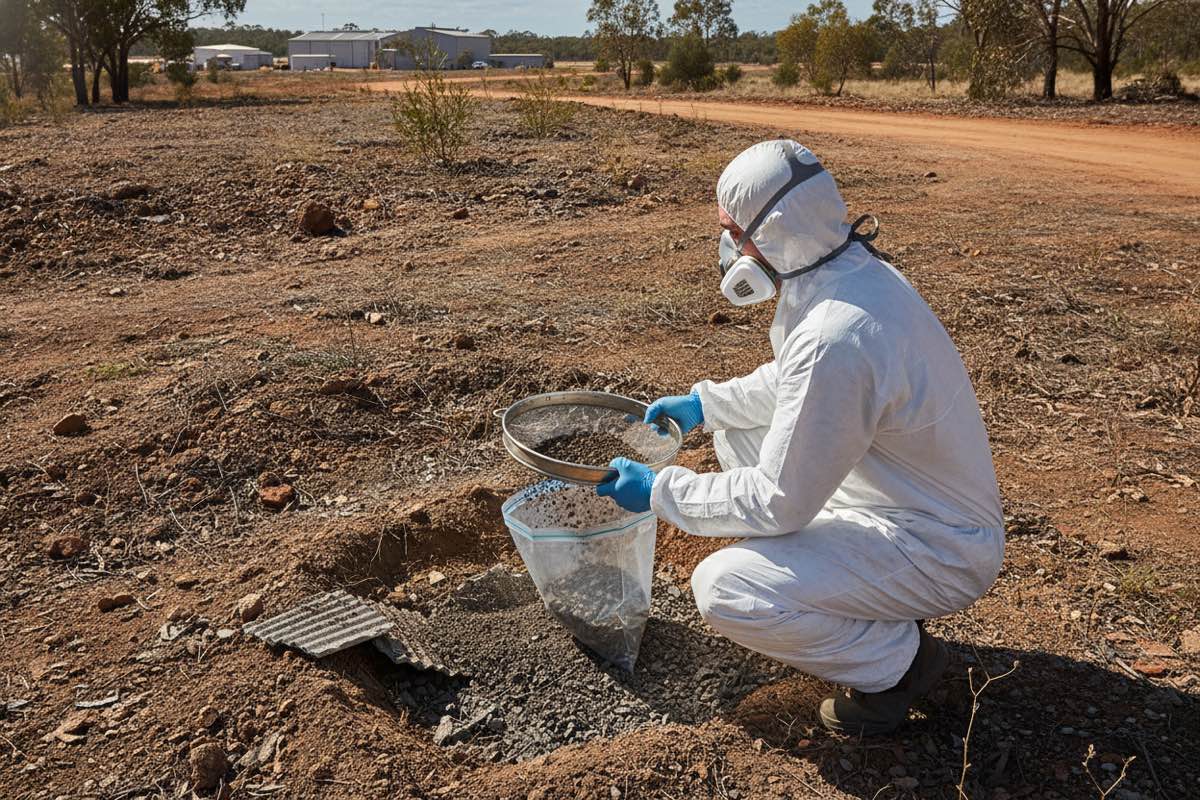
The NEPM notes that inadequate sampling and documentation, rather than laboratory accuracy, are what typically limit asbestos investigations. Schedule B2, adapting the WA guidelines, describes the main methods.
Large area methods
Hand-picking and raking (at least two passes at right angles) suits surface bonded ACM and low levels of FA, although raking may only be effective in sandy soils. Tilling with spotters reaches around 30 cm, depending on the equipment, for bonded ACM only. Mechanical screening suits larger volumes with minor bonded ACM but needs careful dust control. Results are recorded per grid square, generally up to 10 m by 10 m, leaving clean soil out of the calculation so it does not dilute the result.
Test pits, trenches and boreholes
Test pits and trenches are preferred over boreholes because they expose much more soil for inspection. Where boreholes are used, Schedule B2 suggests a core diameter of at least 15 cm. Key requirements from Schedule B2 include:
- sample to 30 cm below the likely limit of contamination, or to the likely maximum depth of disturbance
- take at least one sample of at least 10 L from each relevant layer (or per metre in thick layers), plus extra samples from suspect spots
- screen each 10 L sample by hand on site through a 7 mm sieve and weigh any bonded ACM and FA retained, washing and spreading out clay soils if needed
- where AF sampling is needed, collect at least one separate wetted 500 mL sample from each relevant layer for laboratory analysis.
The WA guidelines add that the AF sample should be its own targeted sample, not taken from the sieved 10 L sample, which dilutes the fines. They also note that AF from broken but sound fibre cement is usually minor, so AF sampling matters most where material has been crushed, burnt or otherwise broken down.
Laboratory analysis
Samples go to a NATA accredited laboratory for identification under AS 5370:2024, Sampling and qualitative identification of asbestos in bulk materials, which superseded AS 4964-2004 in June 2024. It confirms whether asbestos is present but is not a concentration method for free fibres, and the NEPM, written when AS 4964-2004 applied, puts the nominal detection limit of that method at around 0.01%. Suspect fragments can be analysed or simply assumed to contain asbestos.
What happens when results exceed the screening levels
An exceedance of a Tier 1 screening level does not automatically mean everything has to be dug up and trucked away. The NEPM gives two paths: carry out a Tier 2 assessment, or adopt a conservative management response.
A Tier 2 assessment is usually a qualitative risk assessment of the extent of asbestos, how the site will be used, soil type and moisture, and the proposed controls. The NEPM prefers remediation options that minimise soil disturbance and encourages management in place (for example, covering with clean fill over a marker layer, or hardstand). It also recognises that chasing complete removal can mean extensive and costly sampling that is not needed to protect health.
Asbestos left in place needs a management plan, and regulators may add controls such as title notations, register listings, audit statement conditions or planning controls. Dust management and airborne fibre monitoring are commonly needed during earthworks.
Disposal, waste classification and state rules
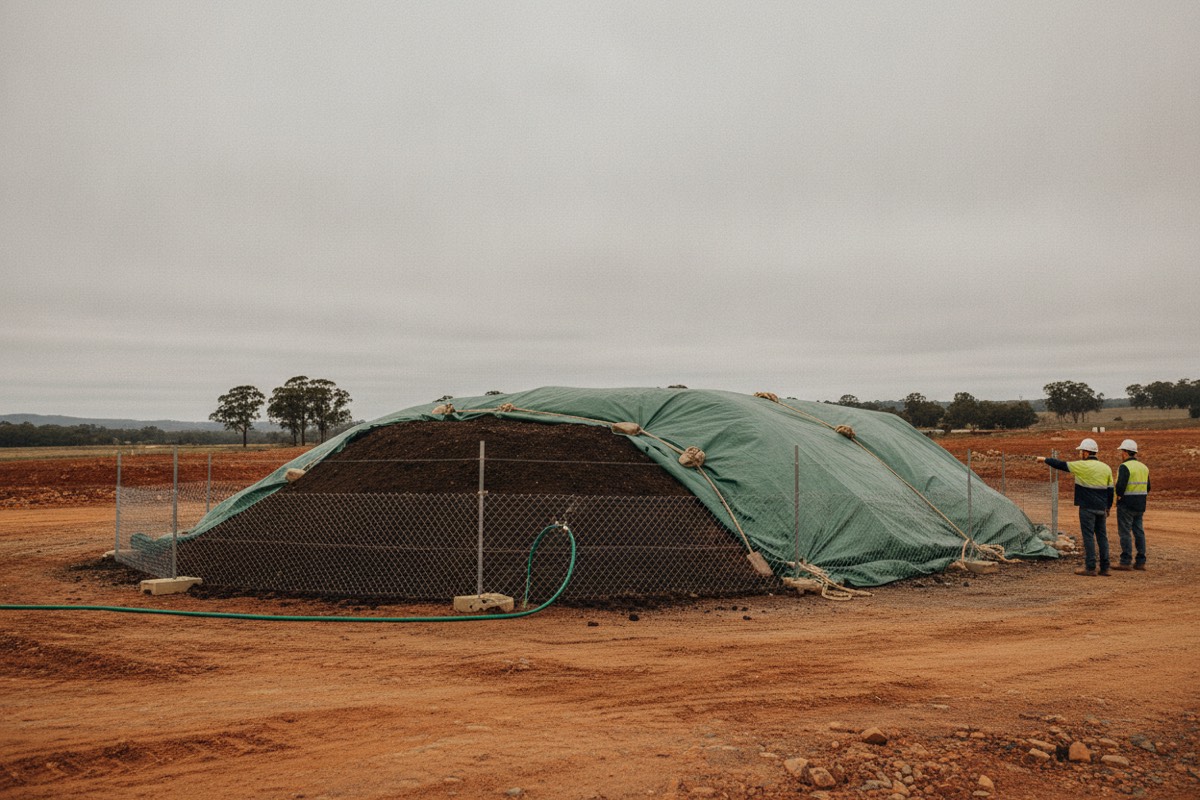
The NEPM says soil known or suspected to contain asbestos should not be reused or recycled at other sites, and that transport and disposal should follow state and territory legislation and guidelines. Asbestos impacted soil leaving a site must be classified and sent to a facility licensed to accept it. For example:
- New South Wales. Asbestos waste is classified as special waste, so asbestos impacted soil cannot be classified as VENM or ENM. Any load of 100 kg or more of asbestos waste, or 10 square metres or more of asbestos sheeting, must be tracked. Since February 2024 this is done through the EPA’s Integrated Waste Tracking Solution, which replaced WasteLocate.
- Victoria. Soil containing asbestos cannot be classified as fill material and is managed as reportable priority waste under the Environment Protection Regulations 2021, with specific requirements for classification, transport and disposal. Each movement must be recorded in EPA Victoria’s Waste Tracker.
- Queensland. Asbestos is regulated waste and trackable waste under the Environmental Protection Regulation 2019, so commercial transport of any quantity, or non-commercial transport of 250 kg or more, must be recorded through the state’s waste tracking system. Asbestos manufacture or disposal is also a notifiable activity under Schedule 3 of the Environmental Protection Act 1994, covering manufacturing asbestos products, disposing of unbonded asbestos or disposing of more than 5 tonnes of bonded asbestos. Land used for a notifiable activity can be listed on the Environmental Management Register (EMR), which affects sales, finance and development approvals.
Handling and removal are also regulated under work health and safety law. Depending on the type and quantity of asbestos, a licensed asbestos removalist may be needed, so check with your state WHS regulator before work starts.
Asbestos in soil on sites under audit
On sites under a statutory audit, or where a regulator has issued a notice, the auditor or regulator will judge the asbestos work against the NEPM and, in many cases, the WA guidelines. In our experience, the investigations that move smoothly through review are the ones where the consultant has clearly documented:
- how the site history shaped where sampling was targeted
- the method, sieve size and sample volume used in each area
- fragment condition, the weight of ACM per sample or grid square, and every assumption in the calculation
- sample locations and depths on a plan, with photographs, and a final surface inspection.
Gaps here are a common reason asbestos reports come back with requests for more information. Agreeing the sampling approach with the auditor before mobilising is usually cheaper than repeating fieldwork.
Common mistakes we see
- Relying only on boreholes in fill where test pits would expose far more soil.
- Assuming 15% asbestos content when vinyl tiles or other non-cement bonded products are present.
- Treating any bonded ACM as a reason for full excavation and disposal without considering management in place.
- Forgetting the surface. Even where every sample passes, the surface must be free of visible asbestos.
How iEnvi can help
iEnvi assesses and manages asbestos in soil across Australia, from targeted investigations to Tier 2 risk assessments, management plans, waste classification and validation, including on sites under audit, sites on Queensland’s EMR and sites subject to regulator notices. Our aim is to protect people while keeping disposal costs and delays under control. Learn more on our asbestos in soil service page, or see our guides to EMR removal in Queensland and when a site audit is required.
If you have found asbestos on a site, or expect to, talk to us early. Call Michael Nicholls on 0411 492 159 or send us a message through our contact page.
References
- National Environment Protection Council. (2013). National Environment Protection (Assessment of Site Contamination) Measure 1999, as amended 2013. Schedule B1: Guideline on investigation levels for soil and groundwater (Section 4, Asbestos materials in soil, and Table 7). https://www.legislation.gov.au/F2013L00768
- National Environment Protection Council. (2013). National Environment Protection (Assessment of Site Contamination) Measure 1999, as amended 2013. Schedule B2: Guideline on site characterisation (Section 11, Asbestos). https://www.legislation.gov.au/F2013L00768
- Department of Health, Western Australia. (2021). Guidelines for the Assessment, Remediation and Management of Asbestos-Contaminated Sites in Western Australia. https://www.health.wa.gov.au/Articles/A_E/Asbestos-contaminated-sites/Guidelines-asbestos-contaminated-sites
- enHealth. (2005). Management of asbestos in the non-occupational environment. Australian Government Department of Health and Ageing.
- Standards Australia. (2024). AS 5370:2024 Sampling and qualitative identification of asbestos in bulk materials (ISO 22262-1:2012, MOD).
- NSW Environment Protection Authority. Integrated Waste Tracking Solution. https://www.epa.nsw.gov.au/Your-environment/Waste/Integrated-Waste-Tracking-Solution
- Environmental Protection Act 1994 (Qld), Schedule 3 (Notifiable activities).
Need advice on this issue? iEnvi provides practical, senior-led environmental consulting across contaminated land, remediation, ecology and environmental risk.
PSI services DSI services Contaminated site assessment Remediation services Talk to iEnvi