

Project overview
iEnvi was engaged to carry out a Delineation Investigation (DI) at an industrial aerosol and paint manufacturing site in northwest Sydney following queries raised by the NSW Environment Protection Authority (EPA) from a baseline investigation. The DI aimed to define the lateral and vertical extent of contamination, assess potential human health and ecological risks, and recommend practical management options for regulatory and commercial outcomes.
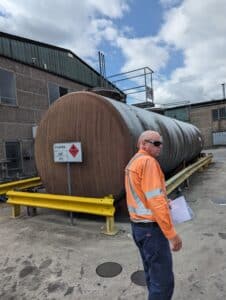
Investigation scope and methods
The DI combined targeted fieldwork with laboratory analysis to confirm areas of potential concern and inform risk-based decisions:
- Installation of three new groundwater monitoring wells to characterise shallow groundwater flow and quality.
- 13 soil bore locations completed to assess surface and sub-surface soil quality near tank farms and process areas.
- Two additional stormwater sampling points to check potential off-site pathways.
- Samples collected: 39 soil samples, 8 groundwater samples and 2 stormwater samples.
- Hydrogeological testing including aquifer slug tests to estimate hydraulic conductivity and groundwater velocity.
- Laboratory chemical suites targeting petroleum hydrocarbons, volatile organics, and a suite of dissolved metals.
Key findings
- Soil: minor hydrocarbon impacts were detected across the site and were generally below Tier 1 screening criteria. One shallow soil sample adjacent to a tank farm exceeded the applicable Tier 1 screening level and is an identified localised source area.
- Groundwater: dissolved metals (cadmium, copper, lead, nickel and zinc) were measured at elevated concentrations in some monitoring wells. The available evidence suggests these concentrations are consistent with local background / natural geochemistry rather than recent site source releases, but confirmation is recommended.
- Vapour intrusion: a small number of hydrocarbon detections in near‑surface soil vapour and soil exceeded Tier 1 screening levels for vapour‑pathway risk. Given the potential inhalation pathway, sub‑slab vapour testing beneath occupied buildings was recommended to confirm whether vapour intrusion represents a reportable risk.
- Hydrogeology: slug-test derived groundwater velocity and travel-time estimates indicated slow groundwater movement and extended travel time to the nearest ecological receptor (surface water body). This reduces the short-term likelihood of contaminant migration to ecological receptors but does not remove the need for targeted management of identified source areas.
Regulatory context — what triggers reporting to NSW EPA
Under the Contaminated Land Management Act (NSW) and the NSW EPA Guidelines on the Duty to Report Contamination, sites must be reported to the EPA when measured concentrations exceed the National Environment Protection (Assessment of Site Contamination) (ASC NEPM) investigation or screening levels and there is foreseeable exposure. Practical triggers include the 95% upper confidence limit on the mean exceeding Health Investigation Levels (HILs) or individual samples substantially above HILs for relevant land use, and confirmed vapour‑intrusion risks beneath occupied buildings.
Interpretation and recommended next steps
- Sub‑slab vapour testing: undertake targeted sub‑slab and indoor air testing beneath representative buildings to resolve whether vapour intrusion creates a regulatory reporting trigger or a need for remediation or vapour mitigation.
- Confirm metals source: complete a focused geochemical/background assessment (including comparison to local background data and, if appropriate, deeper soil profiling) to confirm whether dissolved metals are naturally derived or site-related.
- Targeted source remediation or management: address the shallow soil hotspot adjacent to the tank farm — options include soil removal/containment, capping, or in‑situ treatment depending on the concentrations and redevelopment plans.
- Consider site auditor engagement: if testing confirms reporting triggers or if the site will be subject to a transaction or redevelopment, engage a NSW site auditor early to reduce regulatory uncertainty and speed approvals.
- Document a proportionate environmental management plan (EMP): include ongoing groundwater monitoring, institutional controls or maintenance requirements as relevant to the selected management strategy.
Practical takeaways for owners, developers and purchasers
- The DI has narrowed uncertainty: contamination appears largely localised and manageable, which helps preserve commercial value and reduces the risk of surprise liabilities at transaction or during redevelopment.
- Vapour pathway is the immediate information gap — resolving it quickly (sub‑slab testing) materially reduces time and cost risk.
- Confirming metals are background will avoid unnecessary remediation costs; if metals are site‑derived, targeted actions can prevent escalation to formal EPA regulation.
How iEnvi can help
We can deliver the targeted follow‑up testing, develop a practical site‑specific EMP, quantify costed remediation/management options, and coordinate a site auditor review if required. Early, focused investigations and clear management plans reduce transaction, approval and redevelopment delays.
Contact iEnvi for confidential advice: call 13000 43684 or visit our contact page to discuss your site.
Related services for this project. iEnvi links delivered project work back to the service pathways clients use for similar sites — investigation, remediation, ecology and environmental management.
DSI services Contaminated land advice Environmental management plans Remediation services Talk to iEnvi