

How do you use environmental due diligence findings in an M&A negotiation?
Turn each finding into a defined issue with a reasoned cost range, a likely timeframe and a regulatory position. Known, measurable problems are usually handled through a price adjustment, a specific indemnity or an escrow or retention released on validated remediation or a site audit statement. Unknowns are handled through warranties, which are normally qualified by disclosure. Conditions precedent and exclusions cover issues that must be resolved before completion or kept out of the deal. None of these contract terms changes who a regulator can pursue, so they work best when backed by good evidence. For sellers, the same evidence defends the asking price.
Environmental due diligence findings are only worth paying for if they change something. In a transaction, that means the findings have to move into the price, the sale agreement or the decision to proceed. A data room report listing exceedances without saying what they mean for the deal gives lawyers and financiers little to work with.
This is the third article in our series on environmental due diligence (EDD) for M&A in Australia. The first article explained why environmental due diligence matters in Australian M&A. This one looks at the practical step of using environmental due diligence findings to negotiate price, warranties, indemnities and escrow, from both the buyer’s and the seller’s side.
Turn environmental due diligence findings into something a deal can price
Lawyers draft around defined risks, and financiers price defined risks. The first job after a Phase 1 or Phase 2 is to translate technical results into a short list of issues, each described in a way the deal team can use. For each issue, a useful summary covers:
- What was found and where. For example, petroleum hydrocarbons in soil and groundwater near a former fuel tank, or asbestos in fill across part of a yard.
- How confident we are. Whether the extent is well defined by sampling or still inferred from history and a few results.
- Why it matters. Whether it affects human health or the environment for the current use, the intended use or neighbouring land, assessed against the ASC NEPM (1999, as amended 2013) and relevant state guidance.
- The regulatory position. Whether the site is on a state register or list, such as Queensland’s Environmental Management Register or the NSW EPA’s list of notified sites, whether a regulator is involved or a notice is current, and whether the finding may trigger a reporting duty.
- What it would take to resolve. Further investigation, remediation, ongoing management or simply monitoring, and over what timeframe.
- A cost range. A reasoned estimate with stated assumptions and a contingency.
Phase 1 and Phase 2 are common deal terms. Under the ASC NEPM the equivalent stages are a preliminary site investigation (PSI) and, where needed, a detailed site investigation (DSI). Both should be scoped with this end use in mind, and our article on Phase 1 vs Phase 2 environmental assessments in M&A explains the difference. Results that cannot be turned into a defined issue and a cost range are hard to negotiate with.
Remediation cost estimates and contingency
Cost estimates do most of the work in a negotiation, so they need to be defensible. A good estimate states its assumptions: the volume of soil likely to need excavation or treatment, the expected waste classification and disposal route, the remediation method, validation sampling, groundwater monitoring and any site audit. It should also say what could change the number, such as contamination extending under a building or offsite.
Some contaminants carry more uncertainty than others. Asbestos in fill often drives disposal costs, and PFAS can limit disposal and reuse options. Where PFAS is relevant, assessment and management should follow the PFAS National Environmental Management Plan (NEMP) 3.1.
Because the extent of contamination is rarely known precisely before remediation starts, estimates are best expressed as a range, often with a likely case and a higher case, plus a contingency that reflects how much is still uncertain. Less investigation usually means a wider range, which is one reason buyers often fund targeted Phase 2 work. Our guides to contaminated soil remediation options and remediation action plans explain what goes into these costs.
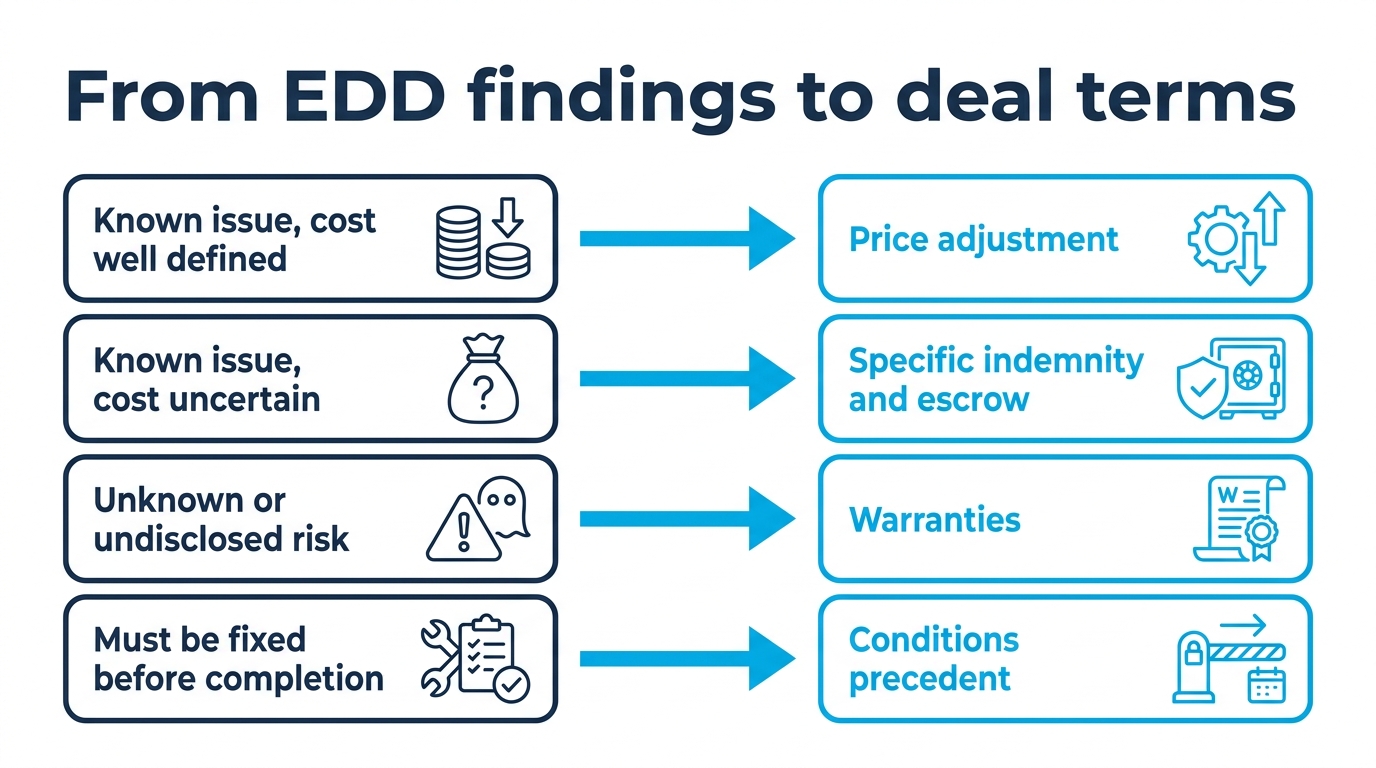
Price adjustment
The simplest response to a known problem is a lower price. A buyer will generally look for a reduction that reflects the estimated cost of investigation, remediation and management, an allowance for uncertainty, and the cost of delay or restricted use while the work is done.
A price adjustment settles the issue between the parties at completion. The buyer takes the risk of the actual cost being higher, and the seller gives up the chance of it being lower. That only works when the estimate is credible. A vague concern rarely moves a price, but a documented finding with a reasoned cost range is hard to dismiss. After completion the buyer, as owner, may be the party a regulator looks to, so the reduction needs to cover that exposure.
Where the parties cannot agree on a number, a price adjustment is often combined with other tools. A smaller price reduction might sit alongside a capped specific indemnity or a retention, sharing the risk rather than fixing it all on day one.
Warranties: protection for what is not yet known
Environmental warranties are statements by the seller about the condition and compliance of the business or site. Typical examples are that all environmental reports have been disclosed, there are no current notices, licences have been complied with, and the seller is not aware of undisclosed contamination. Awareness-qualified warranties are weaker, so buyers often ask for awareness to be defined.
Warranties have limits that matter in an environmental context:
- They are usually qualified by disclosure. If an issue was fairly disclosed in the data room or disclosure letter, the buyer generally cannot claim for it under a warranty. Known contamination will almost always be disclosed.
- They give a claim for loss, not a promise to fix. The buyer has to prove a breach and the loss it caused.
- They are subject to limitations. Caps, thresholds and claim periods agreed in the contract can reduce their value for slow-moving problems like groundwater contamination.
Warranties are best treated as protection against the unknown. Known issues belong in a specific indemnity or the price.
Specific indemnities for known contamination
A specific indemnity is the seller’s promise to pay defined costs if a defined issue causes them. It is the usual tool for contamination that has been found but not fixed. Unlike a warranty claim, it does not usually depend on proving a breach, and it is normally drafted so that disclosure does not cut it down. The technical inputs matter as much as the legal ones. Points to settle include:
- What contamination is covered. The indemnity should identify the issue, the area and the contaminants, ideally by reference to a baseline report and figure so there is no argument later about what existed before completion.
- What triggers a claim. Sellers usually want the indemnity to respond only where remediation is required by law or by a regulator, not where the buyer chooses to redevelop. Buyers may want it to respond to costs needed for the current or an agreed future land use. Sellers may also seek to stop voluntary investigation that could prompt a claim, so buyers should check such a clause still allows work needed for compliance, approvals or finance.
- The standard of clean-up. The end point should be defined, for example suitability for commercial or industrial use against named criteria, confirmed by validation or a site audit, rather than “clean”. The ASC NEPM is an assessment framework rather than a clean-up standard, so the criteria should be stated.
- Who controls the work. Whether the seller or buyer manages remediation, chooses consultants and deals with the regulator, and how claims are notified and costs evidenced.
- Caps, time limits and cost sharing. Specific indemnities often sit outside the warranty limitations with their own cap and term, though this is negotiated deal by deal. Groundwater issues can take years, so the term should match the likely remediation and monitoring period.
Deal structure matters too. In a share sale the target company keeps any liability it has as a polluter. In an asset sale the buyer becomes the owner and may be liable as owner under state law. Either way, an indemnity only allocates cost between the parties. It does not bind the regulator, which can still issue notices to the new owner, leaving the buyer to recover under the contract.
That is why an indemnity is only as good as the seller’s ability to pay. If the seller will distribute the proceeds and wind up, or is a fund near the end of its life, the buyer may need a parent company guarantee, a bank guarantee or an escrow.
Escrow and retention
An escrow or retention holds part of the purchase price back, usually with a third party or in a controlled account, until an agreed environmental outcome is reached. It deals directly with the covenant problem, because the money is already set aside.
The release trigger is where escrow arrangements most often go wrong. Regulators in most states do not issue a general “sign-off” that a site is clean. Where a regulator decision is part of the system, such as site classification in Western Australia or removal from a Queensland register, its timing is outside the parties’ control, so a trigger that depends on it can leave the money stuck. Release is more workable when tied to objective, documented outcomes, such as:
- completion of remediation in line with an agreed remediation action plan, confirmed by a validation report from a suitably qualified and certified consultant
- a site audit statement, or the state equivalent, from an accredited or appointed site auditor confirming the site is suitable for the agreed use, with the agreement saying whether a statement with conditions, such as ongoing management, is enough
- an agreed number of groundwater monitoring rounds showing results within agreed criteria
- a long-stop date, after which the money is released or applied in an agreed way if the outcome has not been reached
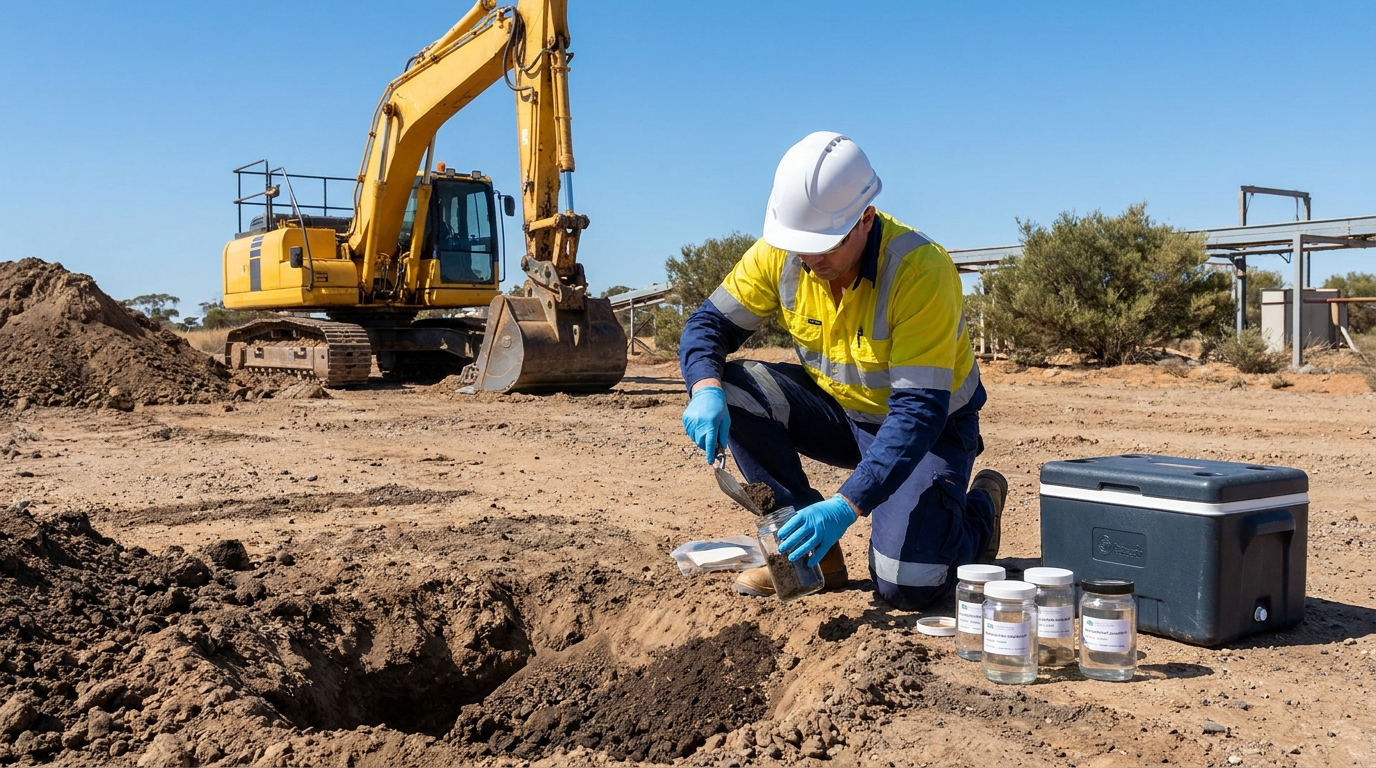
The amount held back should relate to the cost estimate, including contingency, and the agreement should say what happens if the actual cost exceeds the retention. Where an audit is likely, our article on when a site audit is required explains how the audit systems work.
Conditions precedent and exclusions
Some findings need to be dealt with before the buyer will complete at all. Conditions precedent can make completion depend on matters such as the seller carrying out agreed remediation, the transfer or reissue of an environmental licence, the removal or resolution of a notice, or further investigation results falling within agreed limits.
Conditions precedent add time and uncertainty, so they need measurable criteria and a realistic end date. Where a serious issue is confined to one property in a portfolio, the cleaner answer can be to exclude that site.
W&I insurance and environmental risk
Warranty and indemnity (W&I) insurance is common in Australian M&A, but it is not a substitute for environmental due diligence. Policies generally exclude matters the buyer already knows about, and many limit or exclude pollution, particularly where due diligence has not satisfied the insurer. Specific indemnities for known issues are usually outside W&I cover altogether. Specialist pollution liability cover may be available for some risks, but insurers will want to see the due diligence first.
Reporting duties and confidentiality
Findings from intrusive work can trigger legal duties that differ between states. In New South Wales, section 60 of the Contaminated Land Management Act 1997 requires polluters and owners to notify the EPA of contamination that meets the triggers in the EPA’s duty to report guidelines. Victoria’s Environment Protection Act 2017 requires a person in management or control of land to notify EPA of notifiable contamination. In Western Australia, the Contaminated Sites Act 2003 requires owners, occupiers and polluters to report known contamination within 21 days and suspected contamination as soon as reasonably practicable. In South Australia, section 83A of the Environment Protection Act 1993 covers contamination affecting groundwater, and can apply to consultants and auditors as well as owners. Queensland’s Environmental Protection Act 1994 has its own notification provisions, including duties for landowners.
These duties do not wait for the deal to close, and legal professional privilege does not switch them off. Before Phase 2 work starts, the parties should agree who receives results, how they are shared and who makes any notification, with legal advice on privilege and reporting.
The seller’s side: using EDD to protect the price
Issues found late by a buyer often force a price renegotiation at the worst time for a seller. Vendor due diligence reduces that risk. By commissioning a Phase 1, and targeted Phase 2 work where history suggests it, a seller can:
- understand its position before setting price expectations
- fix simple issues before going to market, such as removing waste or redundant tanks, with tank removal validated under state rules such as the UPSS Regulation 2019 in New South Wales
- present remaining issues with context and a defensible cost range, rather than leaving buyers to price in worst-case assumptions
- offer reliance on reports, which can shorten the buyer’s own due diligence
- negotiate indemnities and retentions from an informed position, with realistic caps and release triggers
Buyers usually discount uncertainty more heavily than a known, costed problem, so good evidence protects the price. Our environmental due diligence for property transactions and M&A service covers both buyer and vendor work.
Common mistakes with environmental due diligence findings
- Relying on general warranties for contamination that has already been identified.
- Assuming an indemnity stops a regulator pursuing the new owner.
- Accepting an indemnity from a seller that will not exist, or will have no assets, after completion.
- Tying escrow release to regulator approval that the regulator does not give.
- Leaving the indemnity area undefined, with no baseline report to show what existed at completion.
- Overlooking groundwater, which can extend beyond the site and take years to resolve. See our groundwater investigation services.
- Ignoring underground fuel tanks because they are no longer in use. Our underground petroleum tank page explains the issues.
- Not agreeing how existing regulator notices and orders will be handled after completion.
Why iEnvi specialises in environmental due diligence for M&A
Our work in this area includes:
- Contaminated land assessment, PSIs, DSIs and risk assessment under the ASC NEPM.
- Remediation cost estimates with stated assumptions and contingency.
- Defining indemnity areas and baselines, and technical input to escrow release triggers.
- Remediation planning and validation written to support a site audit.
- National coverage across differing state laws, registers and audit systems.
Our work is led by Michael Nicholls, a Certified Environmental Practitioner and Site Contamination Specialist. You can see the team and credentials behind our reports, and examples such as our baseline environmental due diligence in Western Adelaide.
Talk to iEnvi about your transaction
If you are buying or selling a site or business with any industrial, commercial or agricultural history, talk to us before terms are settled. We can scope due diligence to fit your timetable and give your advisers findings and cost ranges they can negotiate with. Call us on 1300 043 684 or send us a message through our contact page.
This article is general information only and is not legal or financial advice. Contract terms, insurance and environmental laws differ between transactions, states and territories, so get advice that suits your deal and sites.
References
- National Environment Protection Council. National Environment Protection (Assessment of Site Contamination) Measure 1999, as amended 2013.
- Heads of EPAs Australia and New Zealand. PFAS National Environmental Management Plan, Version 3.1.
- Contaminated Land Management Act 1997 (NSW).
- NSW Environment Protection Authority. Guidelines on the Duty to Report Contamination under the Contaminated Land Management Act 1997.
- Protection of the Environment Operations (Underground Petroleum Storage Systems) Regulation 2019 (NSW).
- Environment Protection Act 2017 (Vic).
- Environmental Protection Act 1994 (Qld).
- Contaminated Sites Act 2003 (WA).
- Environment Protection Act 1993 (SA).
Need advice on this issue? iEnvi provides practical, senior-led environmental consulting across contaminated land, remediation, ecology and environmental risk.
PSI services DSI services UPSS investigation and validation Soil remediation Talk to iEnvi