
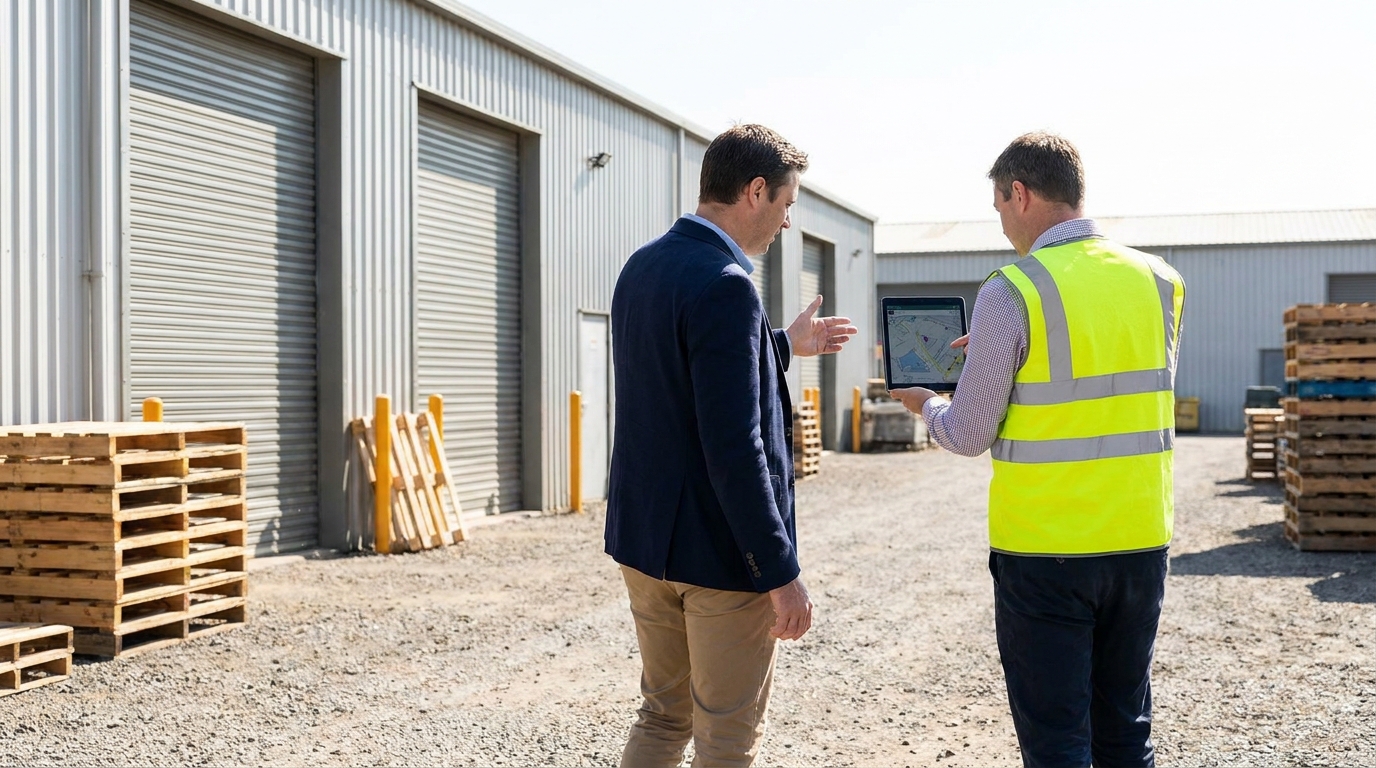
What is vendor environmental due diligence?
Vendor environmental due diligence is an environmental assessment commissioned by the seller before a site or business goes to market. It usually starts with a Phase 1 desktop review and site walkover, adds targeted Phase 2 sampling where the site history points to a likely issue, and ends with a decision on each finding: fix it before sale, or disclose it with a defensible cost range. Done early, it lets the seller set realistic price expectations, narrow the buyer’s own due diligence and negotiate from an informed position, instead of reacting to a buyer’s worst-case assumptions late in the deal.
Most environmental surprises in a sale are not new. The fuel tank, the old fill, the drum store or the neighbouring industry was there all along. What changes is who finds it and when. If the buyer finds it during exclusivity, the seller is negotiating on the buyer’s numbers, on the buyer’s timetable and with less room to move.
This is the fourth article in our series on environmental due diligence (EDD) for M&A in Australia. Earlier articles covered why environmental due diligence matters in Australian M&A, Phase 1 vs Phase 2 environmental assessments and using environmental due diligence findings to negotiate price, warranties, indemnities and escrow. This one is for sellers: how vendor environmental due diligence gets ahead of buyers and protects the sale price.
Why buyers discount uncertainty
A buyer facing an environmental unknown has three choices: walk away, spend time and money investigating it, or price it at the pessimistic end. Under deal pressure, the third option is common. A vague line in an information memorandum such as “historical industrial use” invites the buyer to assume the worst.
A defined and costed issue is different. If the seller can show what the contamination is, where it is, whether it matters for the current use and what a fix would cost, the buyer has less reason to stack contingency. In our experience, buyers and their financiers are far more comfortable with a known problem and a clear cost range than with an open question.
Vendor due diligence also protects the timetable. A late surprise usually means more investigation, a delayed completion and, sometimes, a buyer who loses interest.
When to start vendor environmental due diligence
The best time to start is before the sale price is set, ideally several months before the site goes to market. That leaves time to:
- take legal advice on disclosure, reliance and reporting duties before any intrusive work
- complete a Phase 1 and, if needed, targeted Phase 2 sampling
- get laboratory results back and interpreted
- fix simple issues before buyers see the site
- prepare cost estimates for anything that cannot be fixed in time
Groundwater work takes longer. Installing, developing, settling and sampling monitoring wells can add several weeks, and some states require a bore licence or approval first. One round of results may not be enough to understand a plume or a seasonal trend. If the site history suggests a groundwater issue, such as a former service station, a workshop with an underground tank or a solvent user, start early.
Remediation can carry its own lead times too. In New South Wales, for example, small-scale remediation that does not need development consent usually still requires written notice to the council at least 30 days before work starts. Where the site is leased rather than owned, landlord consent may be needed for sampling or clean up, so check the lease early.
What vendor environmental due diligence usually covers
The scope should follow the site history and the likely buyers. Under the ASC NEPM (1999, as amended 2013), a Phase 1 is broadly a preliminary site investigation (PSI), and a Phase 2 is a targeted or detailed site investigation (DSI).
Phase 1 for the seller
A seller’s Phase 1 normally includes:
- a review of site history, including historical aerial photographs, title searches and business records
- searches of state contaminated land registers and records, such as the NSW EPA’s record of notices and list of notified sites, Queensland’s Environmental Management Register and Contaminated Land Register, EPA Victoria’s Priority Sites Register and environmental audit records, the WA Contaminated Sites Database and the SA EPA public register
- a review of environmental licences, permits and compliance history
- a site walkover to look at fuel storage, chemical stores, waste areas, drainage, stained ground and filled areas
- a check of the asbestos register and hazardous building materials, where buildings are part of the sale
- a conceptual site model that links potential sources, pathways and receptors
A clear register search is not a clean bill of health, because registers only record what has been notified or regulated. The seller often knows things no record shows, such as where an old tank was or where fill came from. A vendor Phase 1 captures that knowledge accurately and in context.
Targeted Phase 2 sampling
Where the Phase 1 identifies a likely issue, targeted sampling turns a suspicion into a defined finding. Typical targets are fuel tanks and bowsers, chemical and drum stores, workshop areas, wash bays, filled ground and any area with stained soil. Where PFAS is a potential issue, for example from historical firefighting foam use, assessment should follow the PFAS National Environmental Management Plan (NEMP) 3.1.
The aim is not to investigate every square metre, but to answer the questions a buyer will ask with enough data to support a cost range.
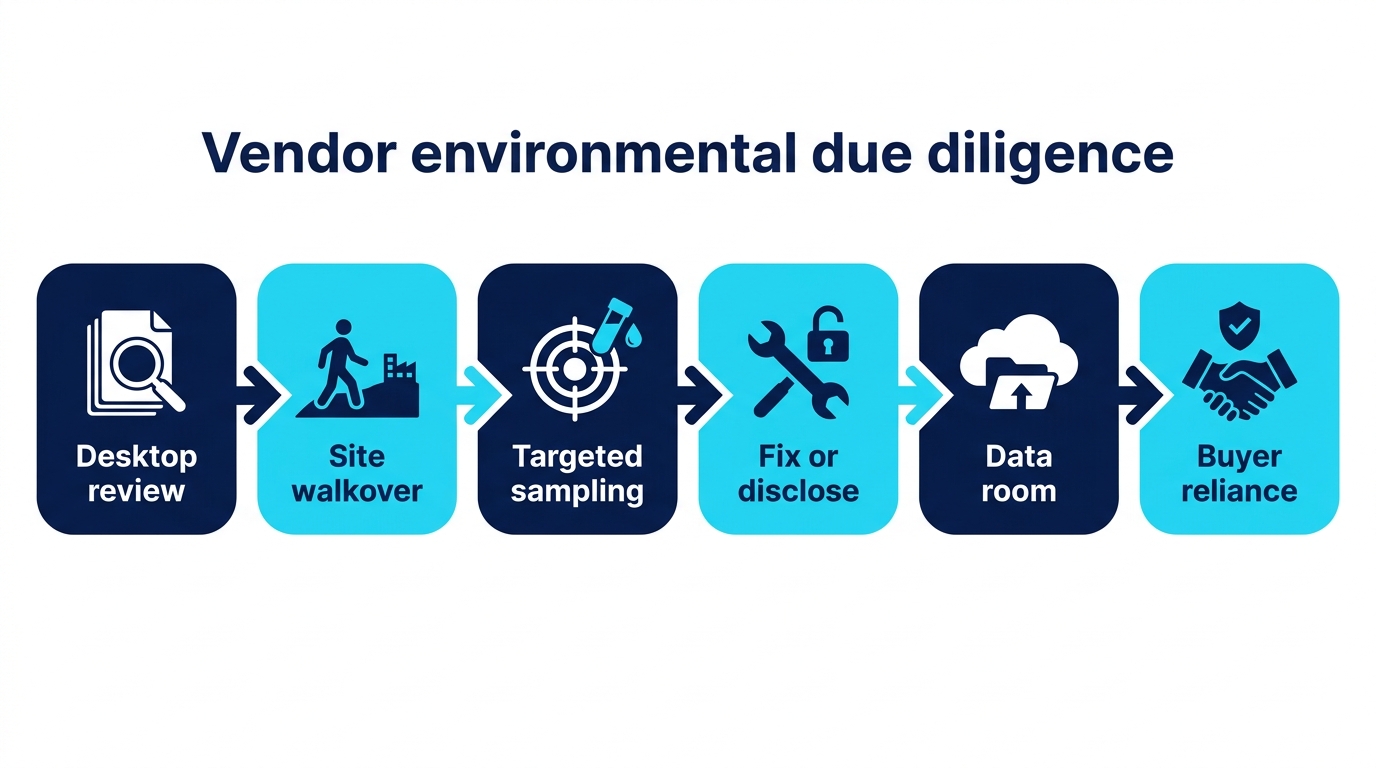
Fix or disclose: deciding what to do with each finding
Each finding needs a decision. Some issues are cheaper to fix than to argue about. Others are better disclosed and priced.
Issues often worth fixing before sale
- Redundant underground fuel tanks. Removing or decommissioning a disused tank, with validation sampling, takes one of the most common buyer concerns off the table. In New South Wales, decommissioning of underground petroleum storage systems is covered by the UPSS Regulation 2019, and other states have their own dangerous goods and environmental requirements. Allow for the possibility that removal uncovers contamination that then needs reporting or further work. Our underground petroleum tank page explains what is involved.
- Waste, drums and stockpiles. Classifying and lawfully disposing of stored waste, old drums and soil stockpiles is often inexpensive compared with the discount a buyer will apply to them, although stockpiles containing asbestos or PFAS can cost more.
- Small, defined hotspots. A small area of impacted soil that can be excavated, disposed of and validated within the sale timetable is often worth removing.
- Paperwork gaps. Missing licence returns, waste records or an out-of-date asbestos register are usually quick to fix.
Any remediation needs a validation report showing what was removed, where it went and what remains. Work done without validation can create more questions than it answers.
Issues better disclosed and priced
Larger or slower problems, such as groundwater contamination, widespread fill or contamination that extends under buildings, may not be fixable before sale. For these, the seller’s best position is a clear technical summary and a defensible cost range with stated assumptions, prepared by its own consultant. Some issues may also need a remediation action plan so the buyer can see how the problem would be managed. How those findings then feed into price, indemnities and retentions is covered in our article on negotiating with environmental due diligence findings.
Disclosure, reliance and confidentiality
Vendor due diligence only protects the price if buyers can rely on it.
Reliance letters
Buyers and their financiers will usually ask to rely on the seller’s reports. A reliance letter from the consultant can allow this on agreed terms, which commonly include a liability cap, a time limit and named relying parties. Whether a cap is shared across relying parties is negotiated deal by deal. Agree reliance at the start, because a report written with reliance in mind is set out differently and more readily accepted by the buyer’s advisers.
Independence and quality
Buyers know the seller paid for a vendor report and will test whether it is thorough and objective. Reports should be prepared by suitably qualified and certified practitioners, follow the ASC NEPM and relevant state guidance, and state their limitations plainly. A report that appears to have been written to reassure rather than to inform will be discounted, and the buyer will commission its own work anyway.
Statutory disclosure on sale
Separately from the data room, some states require sellers of land to disclose certain environmental matters before or in the contract. These rules generally attach to a transfer of land, so they may not apply to a share sale, and leases raise different questions. Examples include:
- Queensland. Section 408 of the Environmental Protection Act 1994 requires an owner, before agreeing to sell, to give the proposed buyer written notice if the land is recorded on the Environmental Management Register or Contaminated Land Register, or is the subject of certain notices or orders. If the notice is not given, the buyer may be able to rescind before completion or possession. Since 1 August 2025, the seller disclosure statement required for most Queensland land sales under the Property Law Act 2023 also asks whether the land is on either register and whether a section 408 notice has been given.
- New South Wales. The planning certificate attached to a contract for sale discloses prescribed matters under the Contaminated Land Management Act 1997, such as declarations of significantly contaminated land and management orders.
- Victoria. The vendor statement under section 32 of the Sale of Land Act 1962 must disclose certain notices, orders and planning information affecting the land, which can include an Environmental Audit Overlay.
Other states have their own vendor disclosure rules. Your lawyer will confirm what applies to your site and sale structure.
Reporting duties
Investigation results can trigger reporting duties regardless of the sale. In New South Wales, section 60 of the Contaminated Land Management Act 1997 requires notification to the EPA of contamination that meets the triggers in the EPA’s duty to report guidelines. Victoria’s Environment Protection Act 2017 requires a person in management or control of land to notify EPA Victoria of notifiable contamination. Western Australia’s Contaminated Sites Act 2003 requires owners, occupiers and polluters to report known or suspected contamination within a set timeframe, so a Phase 1 finding alone may be enough. South Australia’s Environment Protection Act 1993 (section 83A) requires notification of site contamination affecting groundwater, and that duty can fall on the site contamination consultant as well as the owner or occupier.
Sellers should take legal advice before intrusive work starts, so they understand what they may need to report and who will report it. Commissioning work through lawyers may attract legal professional privilege, but privilege does not remove a statutory duty to report, and it may be lost once a report goes into a data room.
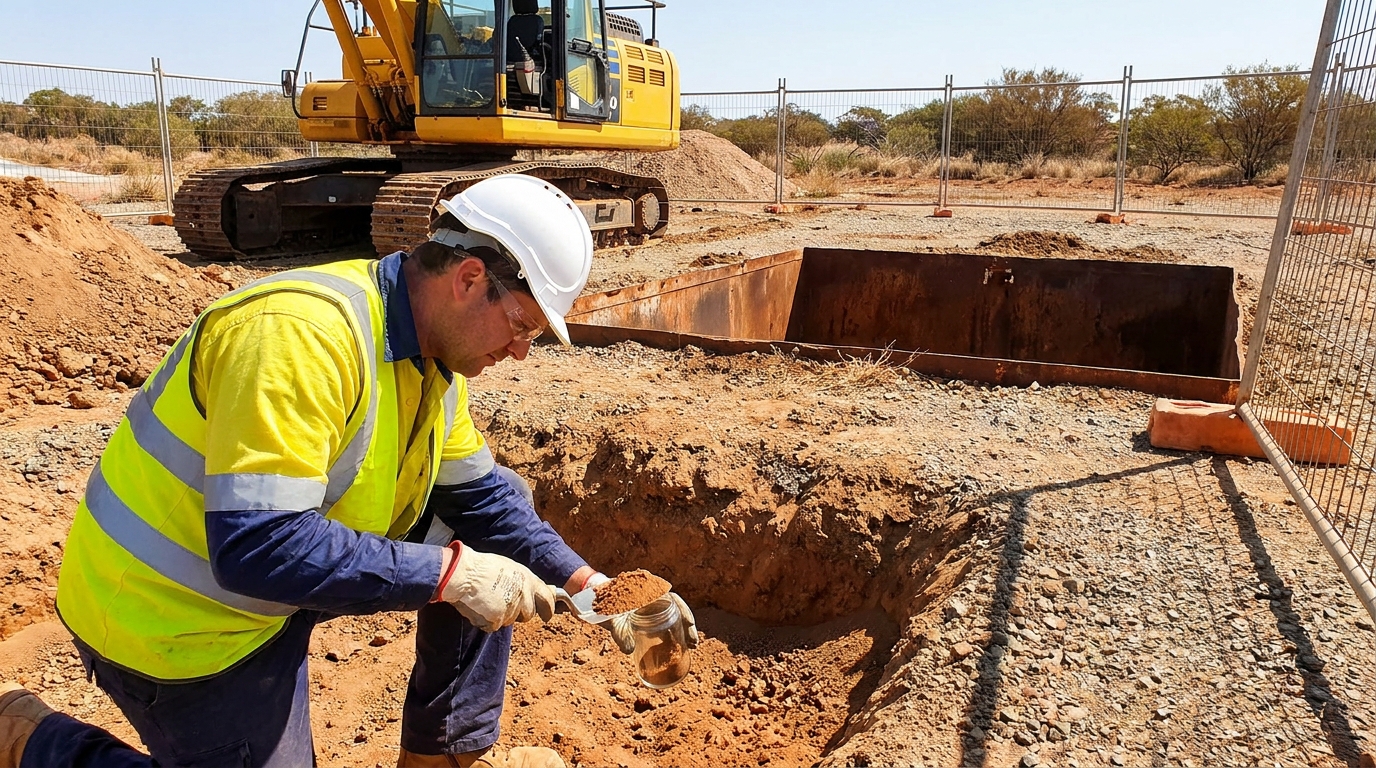
Managing the buyer’s own due diligence
Good vendor due diligence does not stop buyers doing their own work, but it usually narrows it to checking specific areas or confirming vendor results with a few samples.
Sellers can protect themselves by setting the terms of any buyer access in an access licence. Useful points include:
- approval of the buyer’s sampling plan before work starts
- limits on the locations and number of boreholes and wells
- requirements for site induction, insurance and service location before drilling
- reinstatement of the ground, decommissioning of any wells and removal of investigation waste
- an obligation to share results with the seller, and agreement on who makes any notification, keeping in mind that a contractual agreement cannot override a statutory duty
Without these controls, a buyer can drill where the seller has no data and use an unexplained result to reopen the price.
Preparing an environmental data room
A tidy environmental section in the data room tells buyers the site has been well managed. It typically holds:
- the vendor Phase 1 and any Phase 2 reports, with reliance terms
- previous environmental reports, validation reports and any site audit statements, environmental audit statements or audit reports
- register search results and copies of any current or past notices
- licences, permits, annual returns, tank records and waste tracking records
- asbestos registers, management plans, monitoring results and regulator correspondence
Read older reports before they go in. If one recommended further work that was never done, address it in the vendor report rather than leaving buyers to find it.
How vendor environmental due diligence protects the sale price
It replaces worst-case pricing with defined, costed issues, narrows what the buyer needs to investigate, keeps the seller’s consultant explaining the findings and reduces the risk of a late price chip after heads of agreement. It also helps the seller meet its reporting duties and limit open-ended commitments after completion.
Common vendor mistakes
- Starting environmental work after the sale has been announced, leaving no time to fix or cost issues.
- Starting intrusive work before taking advice on reporting duties.
- Removing tanks or contaminated soil without validation, so the buyer cannot confirm what was done.
- Allowing unrestricted buyer drilling without an access licence.
- Overlooking groundwater, which can extend beyond the boundary and take years to resolve.
- Not planning how existing regulator notices and orders will be handled during the sale.
Why iEnvi specialises in vendor environmental due diligence
We prepare vendor environmental due diligence for owners of industrial, commercial and agricultural sites across Australia, including:
- Phase 1 and targeted Phase 2 contaminated land assessment under the ASC NEPM, scoped to the questions buyers ask.
- Fix or disclose advice, including tank removal, waste clean up and small-scale remediation with validation.
- Cost estimates with stated assumptions, reports written for reliance and data room preparation.
- National coverage across differing state laws, registers and audit systems.
Our work is led by Michael Nicholls, a Certified Environmental Practitioner and Site Contamination Specialist. You can see the team and credentials behind our reports, and examples such as our baseline environmental due diligence in Western Adelaide. Our environmental due diligence for property transactions and M&A service covers both vendor and buyer work.
Talk to iEnvi before you go to market
If you are planning to sell a site or business with any industrial, commercial or agricultural history, talk to us before the price is set. We can scope vendor environmental due diligence to fit your sale timetable, fix what can be fixed and give your advisers findings and cost ranges that hold up to buyer scrutiny. Call us on 1300 043 684 or send us a message through our contact page.
This article is general information only and is not legal or financial advice. Contract terms, disclosure obligations and environmental laws differ between transactions, states and territories, so get advice that suits your sale and sites.
References
- National Environment Protection Council. National Environment Protection (Assessment of Site Contamination) Measure 1999, as amended 2013.
- Heads of EPAs Australia and New Zealand. PFAS National Environmental Management Plan, Version 3.1.
- Contaminated Land Management Act 1997 (NSW).
- NSW Environment Protection Authority. Guidelines on the Duty to Report Contamination under the Contaminated Land Management Act 1997.
- Protection of the Environment Operations (Underground Petroleum Storage Systems) Regulation 2019 (NSW).
- State Environmental Planning Policy (Resilience and Hazards) 2021 (NSW).
- Environmental Protection Act 1994 (Qld).
- Property Law Act 2023 (Qld).
- Environment Protection Act 2017 (Vic).
- Sale of Land Act 1962 (Vic).
- Contaminated Sites Act 2003 (WA).
- Environment Protection Act 1993 (SA).
Need advice on this issue? iEnvi provides practical, senior-led environmental consulting across contaminated land, remediation, ecology and environmental risk.
PSI services DSI services UPSS investigation and validation Environmental management plans Talk to iEnvi