
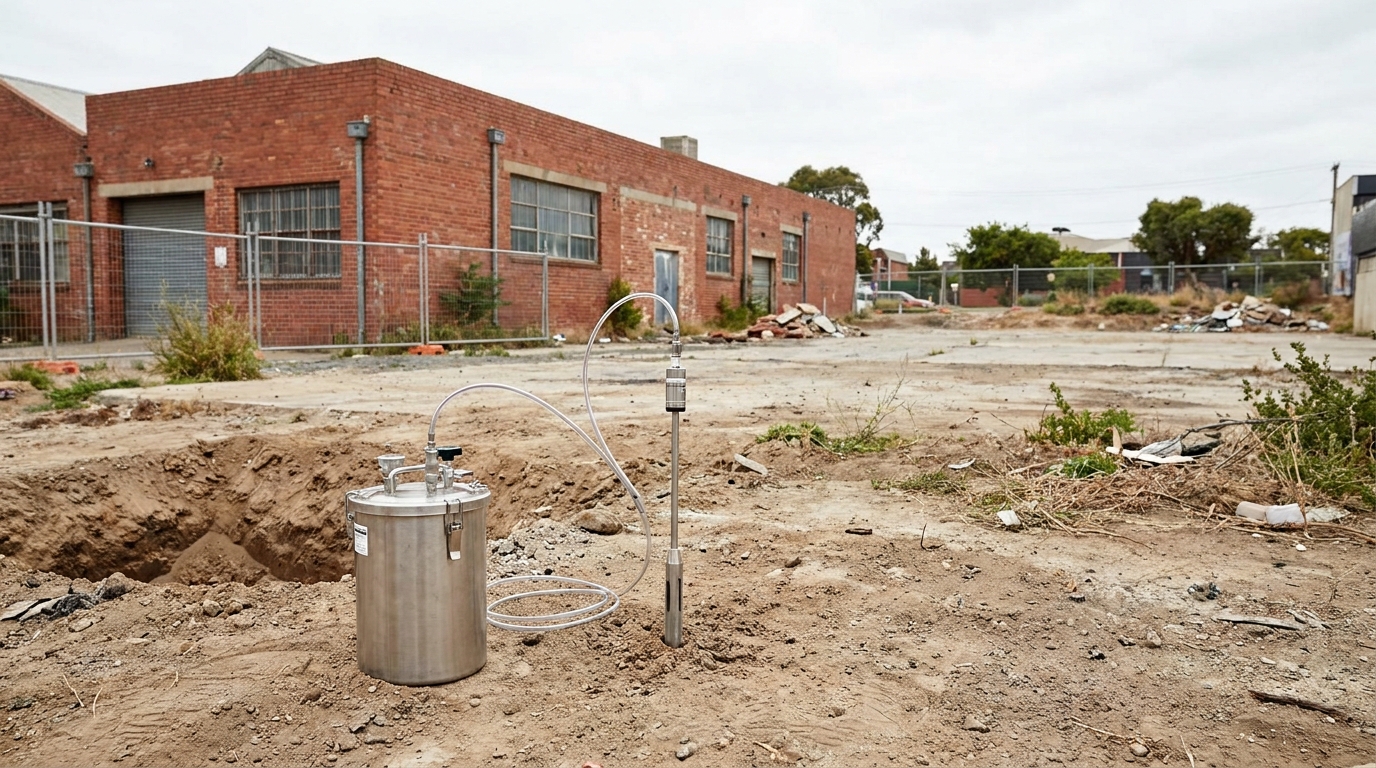
What is a vapour intrusion assessment in Australia?
A vapour intrusion assessment checks whether volatile chemicals in soil or groundwater can move as vapour into a building at levels that matter for health or safety. In Australia it follows the ASC NEPM (Schedules B1 and B2), supported by CRC CARE guidance for petroleum hydrocarbons and enHealth guidance for chlorinated solvents. It usually treats soil vapour as the main line of evidence, compares results to screening levels for the land use, and weighs several lines of evidence rather than one round of samples.
Most contamination questions are about what people might touch or swallow. Vapour intrusion is different: the exposure happens inside a building, often long after the soil has been covered by a slab, and the people exposed may never go near the ground. Petrol and chlorinated solvents from dry cleaning and degreasing are the usual culprits. Diesel is far less volatile and usually less of a concern. They turn up on old service stations, workshops, depots and light industrial land now being redeveloped for housing, childcare, offices or retail.
This guide explains how a vapour intrusion assessment works in Australia, which guidance applies, how soil gas sampling is done properly and what your options are if the numbers come back high.
What vapour intrusion is and why it matters
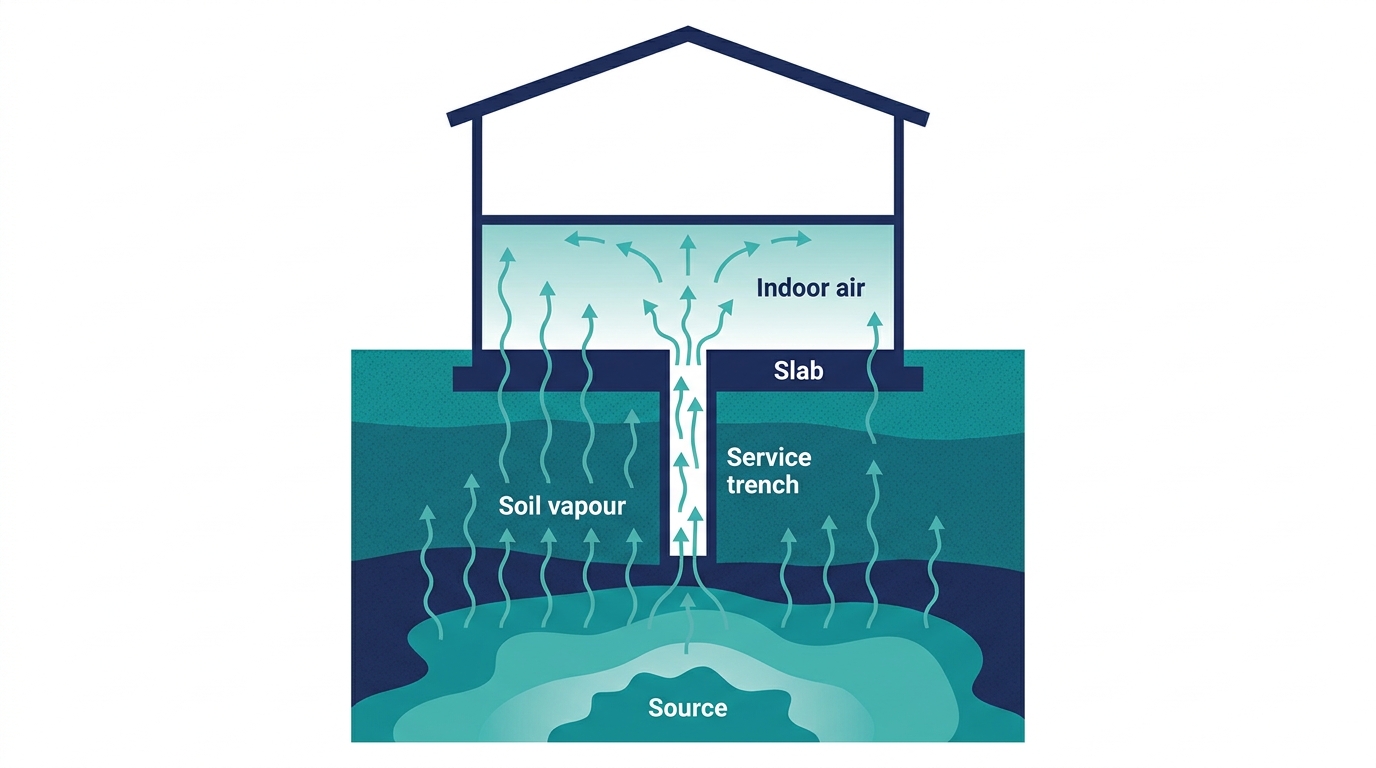
Vapour intrusion is the movement of volatile chemicals from contaminated soil or groundwater, through the unsaturated zone and into indoor air. Vapour moves by diffusion, and pressure differences also draw soil gas into a building through cracks, joints, service penetrations, sumps and lift pits. It can travel sideways along service trenches as well as upward. Inside, vapours can build up in poorly ventilated rooms.
There are two kinds of risk:
- Chronic health risk from breathing low concentrations over years. Benzene and the chlorinated solvents trichloroethylene (TCE) and tetrachloroethylene (PCE) are the chemicals that drive most assessments.
- Acute hazard from flammable or asphyxiating gases, such as petrol vapour in a confined space, or methane and carbon dioxide from fill, a former landfill or organic-rich natural soils.
The pathway is easy to miss. Soil results can look unremarkable while groundwater a few metres down carries a dissolved plume that keeps feeding vapour upward. That is why the conceptual site model matters so much.
The guidance that applies to vapour intrusion assessment in Australia
The National Environment Protection (Assessment of Site Contamination) Measure 1999 (ASC NEPM), as amended in 2013, is the starting point in every state and territory.
- Schedule B1 sets the investigation and screening levels. It includes health screening levels (HSLs) for petroleum hydrocarbons in soil, groundwater and soil vapour, which come from CRC CARE Technical Report 10. The HSLs change with land use, soil texture and depth, so picking the right table matters. Schedule B1 also includes interim soil vapour health investigation levels (HILs) for a small group of volatile chlorinated compounds, including TCE, PCE and vinyl chloride.
- Schedule B2 covers site characterisation. Section 9 deals with vapour assessment: preliminary screening, the conceptual site model, a multiple lines of evidence approach, and active and passive soil vapour sampling methods.
Other documents support the NEPM in practice:
- CRC CARE Technical Report 23 (2013), Petroleum hydrocarbon vapour intrusion assessment: Australian guidance. It gives a decision framework for screening and detailed assessment of both acute hazards and chronic risks. It applies to petroleum hydrocarbons only, not chlorinated solvents or landfill gas.
- enHealth (2023), Guidance for the human health risk assessment of volatile chlorinated hydrocarbon vapour intrusion. It covers attenuation factors, indoor air action levels and how public health agencies weigh the evidence for solvents such as TCE.
- NSW guidance, including the Vapour intrusion: Technical practice note (DECCW, 2010), which predates the 2013 NEPM amendment, and the NSW EPA Assessment and management of hazardous ground gases guidelines (2019, amended 2020), which deal with ground gases such as methane and carbon dioxide.
Other states generally rely on the NEPM and the CRC CARE and enHealth documents, with their own EPA requirements for reporting and, where it applies, site audit. If an auditor is involved, agree the vapour assessment approach with them early. It can save a return trip to the field.
When a vapour intrusion assessment is needed
Expect the vapour pathway to come up when:
- the site, or a neighbour, had a service station, fuel depot, workshop, dry cleaner, metal finisher, printer or chemical store;
- a detailed site investigation found volatile compounds in soil or groundwater, particularly benzene and other BTEX compounds, the lighter TRH fractions (F1 and F2), naphthalene, TCE, PCE or their breakdown products;
- the proposed use is more sensitive than the current one, for example industrial land becoming residential, childcare or aged care;
- the design includes basements, lift pits or slab-on-ground construction over shallow groundwater;
- the site sits on uncontrolled fill or near a former landfill, which raises ground gas questions.
If you are dealing with fuel tanks, the UPSS due diligence guide explains how the tank history feeds into the investigation.
Step 1: Build the conceptual site model
Every good vapour intrusion assessment starts on paper. The conceptual site model answers three questions:
- Source. Where are the volatile chemicals, in what phase (soil, groundwater, free product) and at what depth?
- Pathway. What is the soil like between the source and the building? Sand generally lets vapour move easily and moist clay slows it down, although cracked or fissured clay can behave very differently. Are there service trenches, gravel bedding or old pits that act as preferential pathways?
- Receptor. What building is there now, or will be? Slab-on-ground, suspended floor, basement car park, ventilated undercroft? A basement can put the floor much closer to the source. Who will be inside and for how long?
The model should also flag what can confuse results. Indoor air often contains the same chemicals from everyday sources: fuel in an attached garage, paints, cleaning products, dry-cleaned clothing and some building materials. Skip this step and go straight to indoor air sampling, and you can end up with numbers you cannot interpret.
Step 2: Screen with existing data
Before any soil gas work, compare existing soil and groundwater results against the relevant Schedule B1 HSLs. For petroleum hydrocarbons, that means choosing the right land use (HSL A, B, C or D), soil texture and depth band. For chlorinated solvents, soil and groundwater results are a weaker predictor, so you will usually need soil vapour data even if the screening looks clean.
Screening tells you one of three things: the pathway is clearly not a concern, it clearly needs more work, or the data is not good enough to decide. The third answer is common, and it is a reason to sample soil vapour, not to stop.
For petroleum hydrocarbons, CRC CARE Technical Report 23 recognises that aerobic biodegradation in the unsaturated zone can greatly reduce the vapour reaching a building, provided there is enough oxygen and enough clean soil between the source and the slab. Oxygen can be limited under large slabs and sealed paving, so this needs evidence. Chlorinated solvents do not break down this way to any useful degree. Under anaerobic conditions TCE and PCE can degrade to dichloroethene and the more toxic vinyl chloride, so breakdown does not always mean lower risk.
Step 3: Soil gas sampling done properly
Soil vapour is the main line of evidence in most Australian vapour intrusion assessments. Getting it right is more about field discipline than equipment.
Choosing locations and depths
- Place probes between the source and the existing or proposed building footprint, and under the slab where a building already exists.
- Sample at more than one depth where you can. A vertical profile, read with oxygen and carbon dioxide data, shows whether vapour is attenuating as it rises.
- Keep probes above the water table and the capillary fringe, and deep enough that the sample is not drawing in surface air.
- Target preferential pathways such as service trenches and sumps.
Probe types
- Temporary probes are driven, sampled and removed. They are quick and suit a first look.
- Permanent or semi-permanent probes, including multi-level nests, let you go back for repeat rounds and are better for decisions that affect design or audit.
- Sub-slab probes are drilled through an existing floor and sealed. They give the closest picture of what is sitting right under the building.
- Passive samplers are buried for days or weeks. They are good for mapping and screening but usually give qualitative or semi-quantitative results.
Field quality control
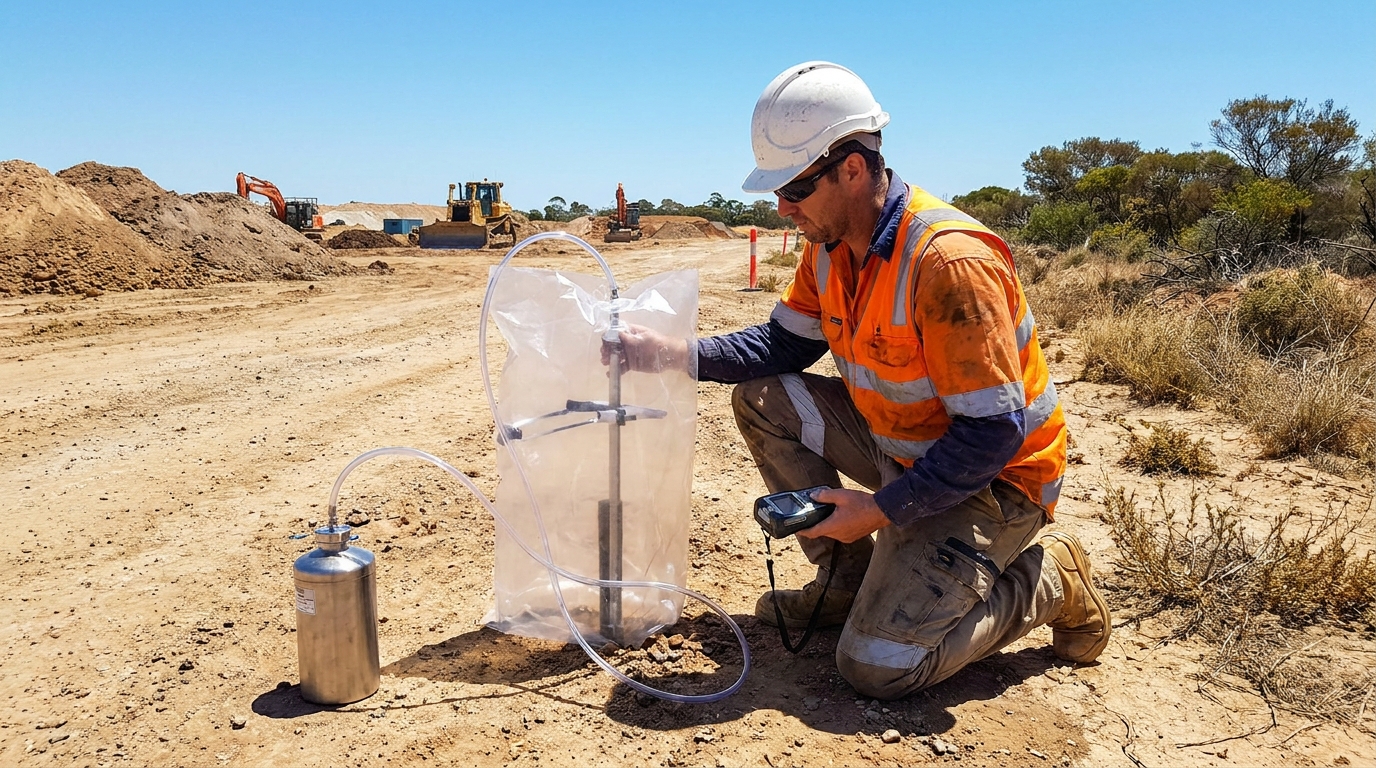
Poor soil vapour data usually comes from leaks and rushed sampling. Good practice includes:
- letting the probe seal settle before sampling;
- purging a small, consistent volume and keeping flow rates and applied vacuum low (CRC CARE Technical Report 23 indicates sample collection vacuum should be less than 8 inHg);
- leak testing every probe and rejecting samples that fail;
- recording oxygen, carbon dioxide and methane, which help explain biodegradation and ground gas;
- collecting field blanks and duplicates, and keeping chain of custody tight.
Leak testing is not optional. CRC CARE Technical Report 23 requires it to demonstrate that soil gas, not ambient air, was sampled. Its Appendix F describes leak testing with a tracer gas, including a helium shroud placed over the probe, and uses 10% of the shroud concentration as the criterion for rejecting a leaky sample. The same discipline applies on solvent sites.
Samples are usually collected into evacuated canisters or onto sorbent tubes, depending on the target chemicals and the reporting limits needed. Appendix I of Technical Report 23 lists US EPA Method TO-15 (canisters) and Method TO-17 (sorbent tubes) as analytical methods generally available in Australia. Check that the laboratory is NATA accredited for the method and analytes, and that its reporting limits sit below the screening levels you will compare against. Missing this is a common reason a round has to be repeated.
Timing and repeat rounds
Soil vapour changes with temperature, rainfall, groundwater level and barometric pressure. A single round can miss the worst case. For anything that will support a development approval, a site audit statement or a sensitive land use, it is usually prudent to plan for at least a second round in different conditions.
Step 4: Assess the results
| Line of evidence | What it tells you | Limitations |
|---|---|---|
| Soil and groundwater data | Where the source is and how big it is | Weak predictor of vapour, especially for chlorinated solvents |
| Soil vapour (external or deep) | Vapour available to migrate towards a building | Varies over time; needs leak testing |
| Sub-slab vapour | What is directly beneath the floor | Only possible where a building exists |
| Indoor and ambient air | What occupants actually breathe | Confounded by indoor and outdoor background sources |
| Building inspection and pressure data | Entry points, ventilation, pressure differences | Qualitative unless paired with sampling |
Results are first compared against the Schedule B1 soil vapour HSLs or interim HILs for the land use. Where they exceed, the next step is not automatically remediation. A site-specific risk assessment can account for actual building design, soil properties, measured attenuation and exposure. For solvents, the enHealth guidance shows how attenuation factors and indoor air action levels fit together. Acute hazards are assessed separately: Technical Report 23 covers petroleum vapour, and in NSW the hazardous ground gas guidelines cover methane and carbon dioxide.
Indoor air sampling has a place, but usually after soil vapour, not before. Remove or record household and workplace chemicals first, note how the ventilation was running, sample outdoor air at the same time, and treat a single indoor result with caution. If solvents such as TCE are found under an occupied building, involve the health and environmental agencies early and check whether your state has a duty to notify the EPA.
Step 5: Manage the risk
If vapour intrusion is a real risk, the options fall into three groups:
- Source reduction. Remove or treat the soil or groundwater driving the vapour. This can include excavation, soil vapour extraction or other soil remediation methods, and groundwater treatment where a dissolved plume is the source.
- Building controls. Vapour barrier membranes under slabs, passive venting layers, active sub-slab depressurisation, sealing of service penetrations and ventilated undercroft or basement car parks.
- Administrative controls. A long-term environmental management plan, restrictions on use, ongoing monitoring and, in some states, notation on title or a planning control.
For a new building, designing controls in at the start is usually far cheaper than retrofitting. A standard damp-proof membrane is not a vapour barrier for these chemicals, so membranes and venting layers need a chemical-resistant specification, careful installation and inspection before the slab is poured. Ask for installation records and photographs: a damaged membrane gives little protection, and an auditor will want evidence it was installed as designed. Active systems also need ongoing maintenance and monitoring, which belongs in the management plan.
Common mistakes we see
- Relying on soil results and missing a groundwater plume.
- One round of temporary probes used to sign off a sensitive land use.
- No leak testing, so ambient air dilutes the sample and results look better than they are.
- Laboratory reporting limits above the screening levels.
- Indoor air sampling with no background survey, then trying to explain the numbers afterwards.
- Using petroleum HSLs and biodegradation arguments for chlorinated solvents, where they do not apply.
- Leaving the vapour pathway until after design is locked in, when controls are harder and more expensive.
How iEnvi can help
iEnvi assesses vapour intrusion as part of preliminary and detailed site investigations for developers, owners, lenders and buyers across Australia. We build the conceptual site model first, design soil gas programs with auditor review in mind, and help you weigh source treatment against building controls so you are not paying for more than the risk needs. Where vapour intrusion is live in a purchase or sale, we can frame the findings to support your negotiation, not only your compliance.
Talk to iEnvi
If you have a site with a fuel, solvent or ground gas history and a change of use coming, call us on 1300 043 684 or get in touch to talk through what level of vapour intrusion assessment you need.
Disclaimer: This article is general information only and is not advice for any particular site. Requirements differ between states and change over time. Get site-specific advice from a suitably qualified environmental professional before making decisions.
References
- CRC CARE. (2013). Petroleum hydrocarbon vapour intrusion assessment: Australian guidance (Technical Report No. 23). CRC for Contamination Assessment and Remediation of the Environment.
- Department of Environment, Climate Change and Water NSW. (2010). Vapour intrusion: Technical practice note. DECCW.
- enHealth. (2023). Guidance for the human health risk assessment of volatile chlorinated hydrocarbon vapour intrusion. Australian Government Department of Health and Aged Care.
- Friebel, E., & Nadebaum, P. (2011). Health screening levels for petroleum hydrocarbons in soil and groundwater (Technical Report No. 10). CRC for Contamination Assessment and Remediation of the Environment.
- National Environment Protection Council. (2013). National Environment Protection (Assessment of Site Contamination) Measure 1999, as amended 2013: Schedule B1 Guideline on investigation levels for soil and groundwater. NEPC.
- National Environment Protection Council. (2013). National Environment Protection (Assessment of Site Contamination) Measure 1999, as amended 2013: Schedule B2 Guideline on site characterisation. NEPC.
- NSW Environment Protection Authority. (2020). Assessment and management of hazardous ground gases: Contaminated land guidelines (amended). NSW EPA.
Need advice on this issue? iEnvi provides practical, senior-led environmental consulting across contaminated land, remediation, ecology and environmental risk.
DSI services UPSS investigation and validation Soil remediation Groundwater investigation and treatment Talk to iEnvi