
How should PFAS liabilities be handled in a transaction?
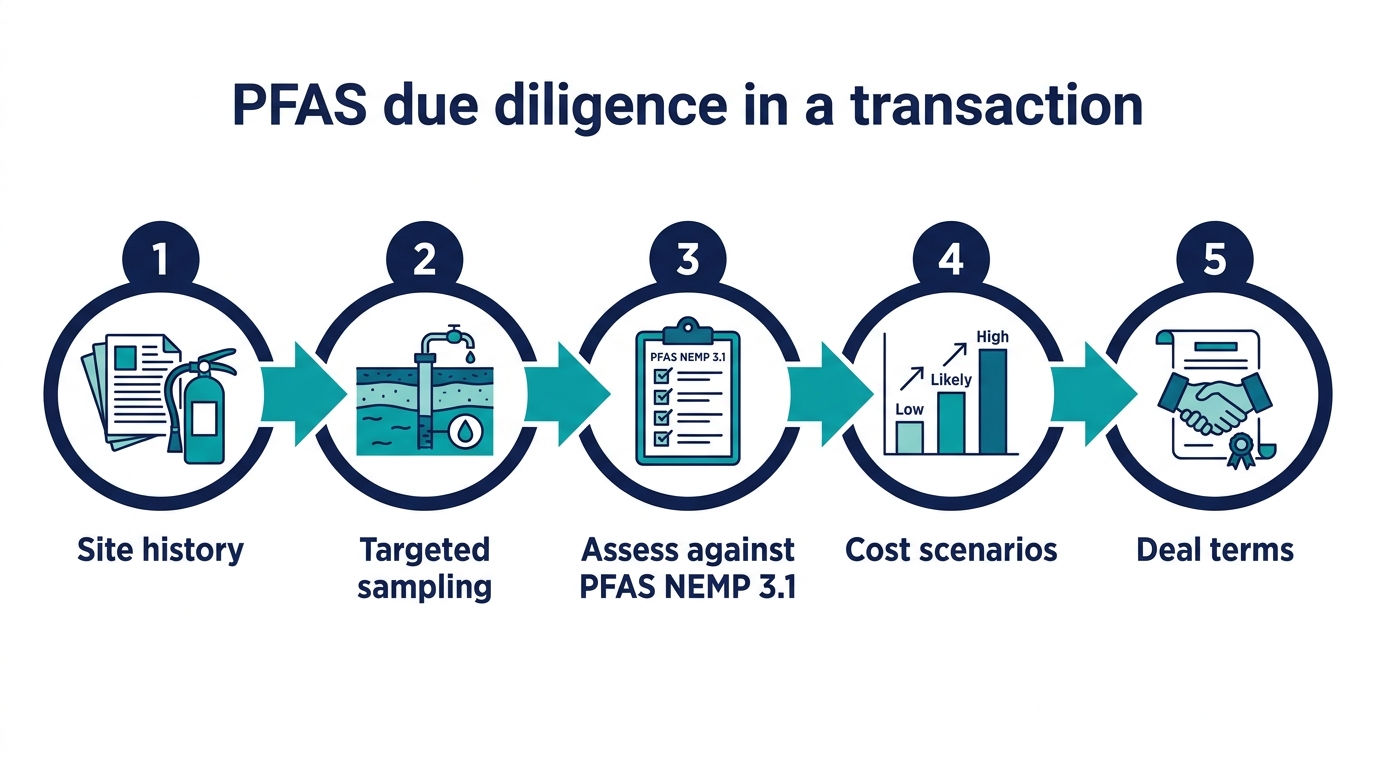
PFAS liabilities in transactions are the costs and legal exposures that come with per- and polyfluoroalkyl substances (PFAS) in soil, groundwater, concrete or fire systems at a site being bought, sold or financed. They are handled by screening every site for likely PFAS sources early, sampling where the history points to a risk, assessing results against the PFAS National Environmental Management Plan Version 3.1 (PFAS NEMP 3.1) as applied in the relevant state or territory, and then costing realistic scenarios for clean-up, waste disposal, groundwater and third-party claims. Those costed scenarios inform the price, specific indemnities, retentions and conditions. A defined PFAS issue can usually be priced. An undefined one tends to be priced at the worst case, or stalls the deal.
PFAS now comes up regularly in Australian transactions, and when it does it can change the terms of a deal. The chemicals are persistent, many move readily in groundwater, the guideline values they are assessed against are very low, and soil containing them can be hard and expensive to dispose of. A site that looks clean in a standard contamination screen can still carry a PFAS problem if nobody asked the right questions.
This is the fifth article in our series on environmental due diligence (EDD) for M&A in Australia. Earlier articles covered why environmental due diligence matters in Australian M&A, Phase 1 vs Phase 2 environmental assessments, using environmental due diligence findings to negotiate price, warranties, indemnities and escrow and vendor environmental due diligence. This one looks at PFAS liabilities in transactions: where they come from, how to find them and how to turn findings into deal terms.
Why PFAS liabilities in transactions are different
Hydrocarbons, metals and asbestos have settled investigation methods and familiar disposal routes. PFAS is harder for several reasons.
- Persistence. PFOS, PFOA and similar PFAS do not break down in the environment in any practical timeframe, and some precursor compounds slowly transform into them.
- Mobility. Many PFAS dissolve readily and travel with groundwater and surface water, so a plume can extend well beyond the site boundary.
- Low guideline values. Drinking water values are set at very low concentrations. The NHMRC revised the Australian Drinking Water Guidelines values for PFAS in June 2025, and PFAS NEMP 3.1 incorporates them.
- Waste disposal. Not every landfill accepts PFAS-affected soil. Acceptance depends on state waste classification rules, concentrations, leaching behaviour and the individual landfill’s licence, and in some states the acceptance criteria are still based on earlier NEMP versions.
- Limited treatment options. Destruction options for PFAS in soil and water are limited and costly, so many projects rely on containment, immobilisation or water treatment rather than removal.
- Changing regulation. The PFAS NEMP has been revised several times since the first version, and controls on the chemicals themselves have tightened.
For a buyer, that creates a long tail that can outlast the hold period and affect a future sale. For a seller, an unexplained PFAS question late in a deal hands the buyer a reason to cut the price or ask for open-ended protection.
Which sites carry PFAS risk
PFAS risk follows site history. A preliminary site investigation (Phase 1) for a transaction should ask specifically about PFAS sources, not just about fuel and chemical storage. Sites and activities that warrant a closer look include:
- sites where firefighting foam was used, stored, tested or used in training, including fire stations, training grounds, airports, ports and defence sites
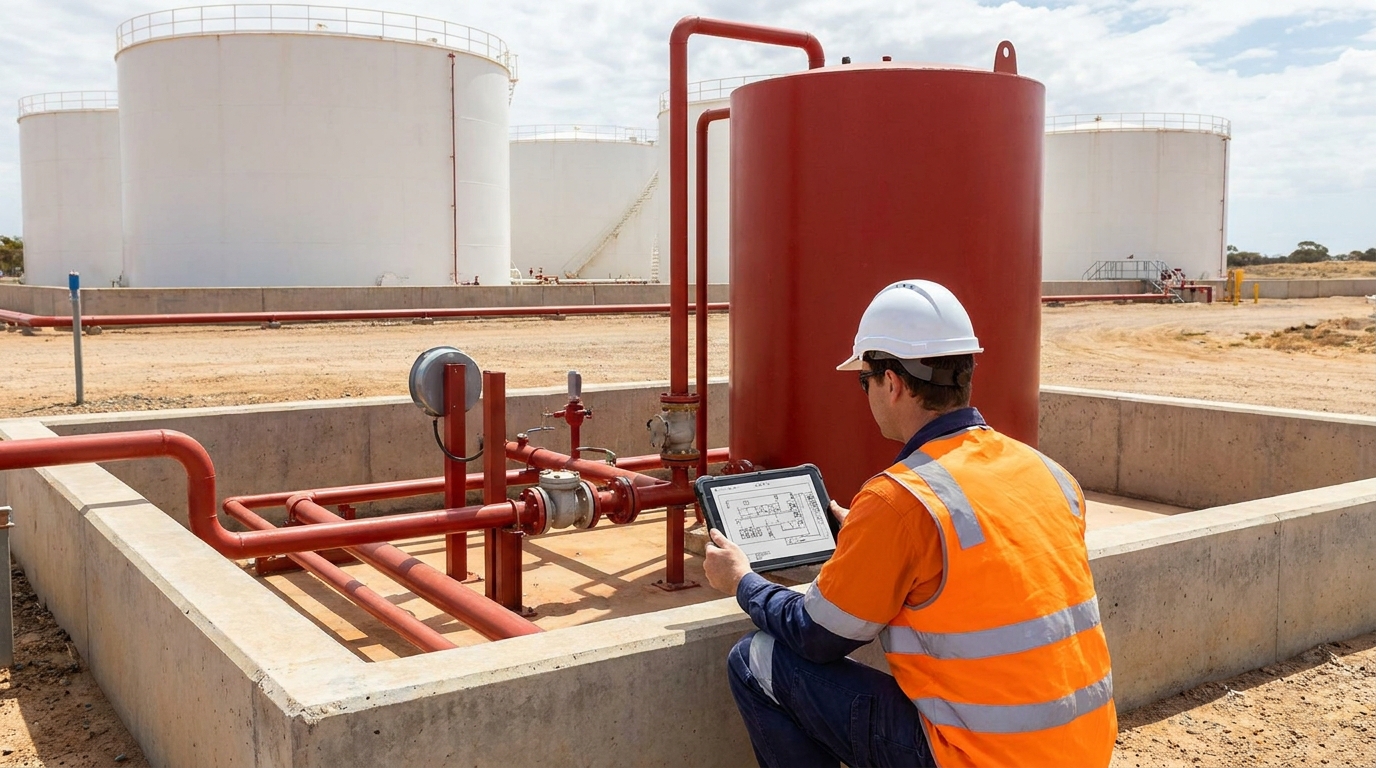
- fuel terminals, refineries, bulk chemical stores and tank farms with fixed foam systems
- aircraft hangars and large warehouses with foam deluge or sprinkler systems
- fire equipment servicing and foam supply businesses
- sites where a significant fire was fought, particularly with foam
- chrome plating and metal finishing, where some mist suppressants contained PFOS
- textile, carpet, leather, paper and packaging treatment
- landfills, wastewater treatment plants and sites that received waste, biosolids or imported fill of unknown origin
- sites downgradient of any of the above, where PFAS may arrive in groundwater from a neighbour
Some sources are easy to miss. A foam system may only ever have been discharged during testing, and old concentrate may still sit in a plant room. Records are often incomplete, so interviews with long-serving staff can be as useful as aerial photographs. The neighbourhood matters too: a clean site next to a former fire training area can still have PFAS in groundwater beneath it, which affects dewatering, groundwater use and how a lender views the site.
What PFAS NEMP 3.1 means for due diligence
The PFAS National Environmental Management Plan is the national framework for assessing and managing PFAS contamination. It is prepared by the Heads of EPAs Australia and New Zealand (HEPA) and implemented by each state and territory through its own laws and policies, and by the Commonwealth on Commonwealth land. PFAS NEMP 3.1, released in June 2026, is the current version. See our article on PFAS NEMP 3.1 and what changed for site investigations, and our overview of national regulation and guidance for PFAS.
For transactions, the key points are:
- It is guidance, applied through state frameworks. NEMP values are screening and investigation values. Exceeding one triggers further assessment, not automatic remediation. States decide how and when they adopt each update, and some regulators, such as the NSW EPA, publish position statements on this. The report should state which NEMP version and criteria were used, and why.
- Drinking water values changed. PFAS NEMP 3.1 incorporates the June 2025 drinking water values. Groundwater data screened against the previous values needs to be re-screened before it is relied on in a deal.
- PFOS ecological water values changed. NEMP 3.1 adopts the March 2026 ANZG freshwater values for PFOS and applies them on an interim basis to marine waters. Sites that discharge to, or sit close to, creeks, estuaries or wetlands need these values checked.
- Most other content carried over. The supporting documents and most other NEMP 3.0 criteria, including the risk-based framework and the guidance on waste and soil reuse, were carried forward into 3.1.
An older PFAS report may not answer the questions a buyer or lender will ask now. Re-screening existing data can be enough, but only if the laboratory limits of reporting were low enough to compare with the current values and the data still represent site conditions. Older results reported as “not detected” may not demonstrate that PFAS is below today’s drinking water values.
How PFAS is investigated in a transaction
Phase 1: is PFAS a realistic concern?
The Phase 1 should say whether PFAS is a realistic concern, and where. That needs a site history review, a walkover that looks for foam systems, foam stores, bunded areas and drainage, interviews, and a check of regulator and public information about PFAS investigations in the area. The output should be a short list of likely source areas and pathways, not a general statement that PFAS “may be present”.
Phase 2: targeted PFAS sampling
Where the Phase 1 identifies a realistic source, a targeted detailed site investigation (Phase 2) can confirm whether PFAS is present and at what levels. A transaction-focused PFAS program typically includes:
- soil sampling at likely release points, such as foam test areas, bund outlets, drains and fire incident locations
- concrete and pavement sampling where foam was discharged onto hardstand
- groundwater sampling, because groundwater usually drives off-site risk and long-term cost
- surface water and sediment sampling where the site drains to a waterway
- leachability testing on soil likely to be excavated, to support waste classification and disposal decisions
Porous hardstand, bunds and pits can hold PFAS for years and keep releasing it with rainfall. If the buyer plans demolition, PFAS in concrete affects whether crushed concrete can be reused or must be disposed of as waste.
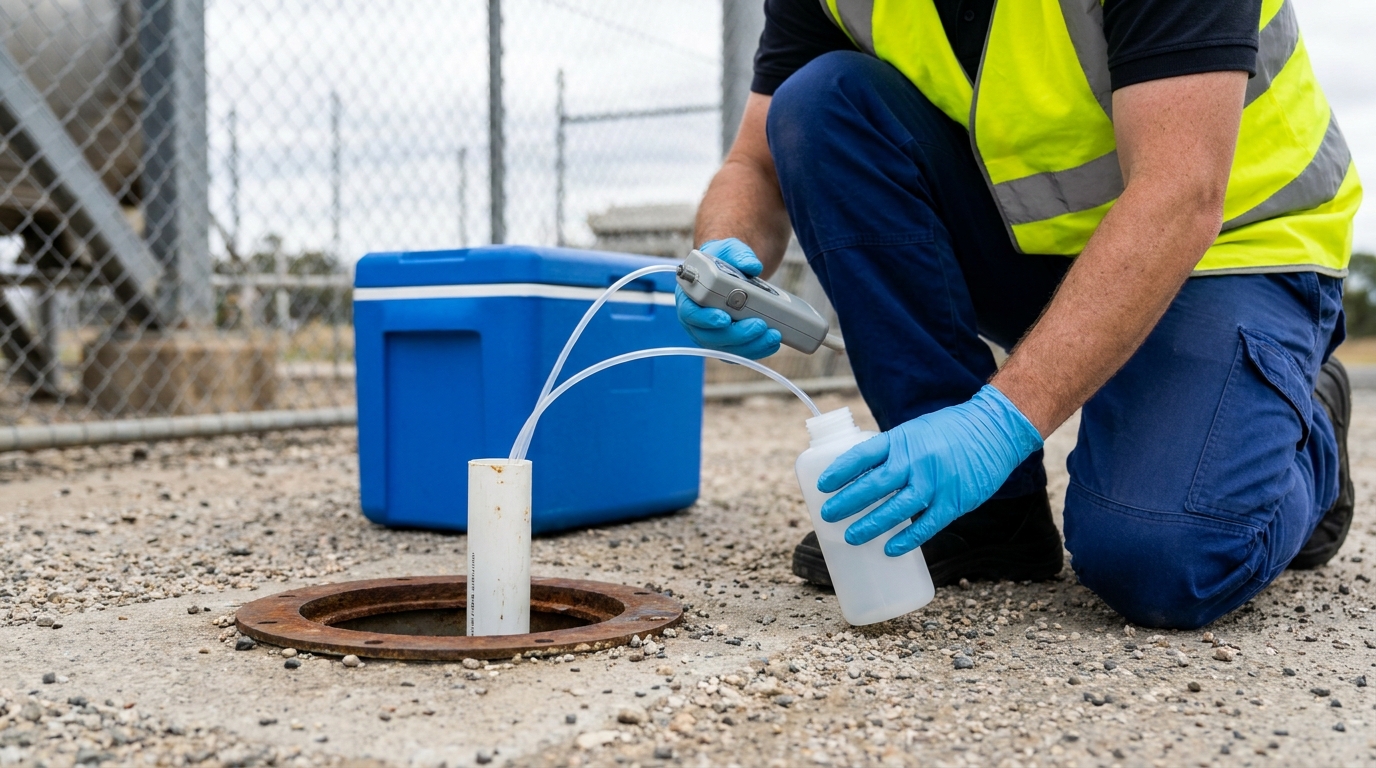
PFAS sampling needs care. Some waterproof clothing, equipment and personal care products contain PFAS, so field teams use PFAS-free equipment and laboratory-supplied containers, and collect field and rinsate blanks to show cross-contamination has not affected results. Samples go to NATA-accredited laboratories with limits of reporting low enough for the criteria being applied. Our step-by-step guide to low flow groundwater sampling explains the general approach. The total oxidisable precursor (TOP) assay can indicate how much additional PFAS may form from precursors, but it does not identify individual precursors or capture all of them, as covered in our article on TOPA and PFAS precursor detection.
Turning PFAS findings into costs
Laboratory results alone do not set a price. Findings need to become a few realistic cost scenarios with stated assumptions. Common PFAS cost drivers include:
- Further investigation to define the extent of soil and groundwater impact, including off-site.
- Waste disposal for soil that must be excavated for development, where classification, landfill acceptance and transport can dominate the budget. Our waste and beneficial reuse team works through on-site reuse options under the NEMP framework and the relevant state approvals before disposal is assumed.
- Remediation or management, which for PFAS often means containment, capping or immobilisation under a remediation action plan rather than full removal.
- Fire system change-over, including decommissioning legacy foam, cleaning or replacing system components and disposing of old concentrate and rinse water. The replacement system still has to meet fire safety and insurer requirements.
- Construction water treatment where dewatering is needed, and ongoing monitoring, sometimes for many years.
- Regulatory and third-party exposure, including notices, neighbour claims and impacts on groundwater users.
For PFAS, the cost range usually turns on how much soil and concrete the buyer’s plans will disturb, how that material will be classified in the relevant state, and whether groundwater impact has moved off site. Targeted work on those questions narrows the range faster than broad sampling.
Using PFAS findings in the deal
Once the PFAS position is defined and costed, it can be handled with the same tools covered in our article on negotiating price, warranties, indemnities and escrow. PFAS raises some specific points. What is achievable depends on bargaining position and legal advice.
For buyers: managing risk
- Specific indemnities. General environmental warranties are usually capped and time-limited. Because PFAS liabilities can emerge slowly, buyers often seek a specific PFAS indemnity with a cap and duration linked to the cost scenarios. The definition matters: an indemnity limited to a few named compounds may miss precursors and other PFAS, and it should be clear whether off-site migration and regulator-directed works are covered.
- Insurance gaps. Warranty and indemnity insurance does not normally cover matters already known to the buyer, and PFAS is often excluded altogether. Standalone environmental policies usually exclude known conditions and may exclude or limit PFAS. Check the policy wording before assuming risk has been transferred.
- Retentions and escrow. Holding back part of the price until defined work is complete, or until agreed monitoring milestones are met, links payment to outcomes.
- Conditions and pre-completion works. A buyer may negotiate for the seller to decommission legacy foam systems or complete defined investigation before completion.
- Financier requirements. Lenders may ask for PFAS to be addressed specifically, and clear reporting can reduce delays at credit approval.
For buyers: price leverage
A well-defined PFAS finding also gives a buyer a firm basis for a price adjustment. A costed scenario prepared by a suitably qualified consultant, using current criteria under PFAS NEMP 3.1 and the relevant state framework, is much harder for a seller to dismiss than a general concern.
For sellers: protecting the price
Sellers benefit from getting ahead of PFAS questions, as we discussed in our article on vendor environmental due diligence. If a site has any PFAS history, a targeted screen before going to market lets the seller:
- show that PFAS is absent or limited, where that is the case
- plan the decommissioning of legacy foam and lawful disposal of old concentrate, and disclose the history and records
- present a defined issue with a cost range instead of an open question
- negotiate any indemnity cap and duration from an informed position
Removing foam does not remove the history, and buyers will ask about it. Sellers should also take legal advice before intrusive sampling. Reporting duties differ between states, may be triggered by results and, in some states, can also apply to the consultant. Legal professional privilege does not remove a statutory duty to notify.
Regulatory and third-party exposure
From 1 July 2025, PFOS, PFOA and PFHxS were listed in Schedule 7 of the Industrial Chemicals Environmental Management Standard (IChEMS). The listing restricts their manufacture, import, export and use, subject to specific exemptions, and includes measures for managing waste containing them. IChEMS is given effect through state and territory laws. Several states, including Queensland, South Australia and New South Wales, had already restricted PFAS firefighting foams. Remaining PFAS foam stocks or systems in a business being acquired are a compliance question as well as a contamination one, so confirm whether any exemption actually applies.
Contamination itself can trigger state reporting duties, regulator notices or orders and, where PFAS has migrated, claims from neighbours or groundwater users. In many states a regulator can direct an owner or occupier, not only the party that caused the contamination, so a buyer can inherit obligations for PFAS it did not release. If a site already has a regulator notice, order or management plan, the buyer needs to understand what it requires and who will carry it after completion. Our regulator notice and order response service can help.
Common PFAS due diligence mistakes
- Assuming a standard contamination suite covers PFAS.
- Ignoring fire systems because they have never been used in a fire, when testing and leaks also release foam.
- Sampling only soil, or ignoring concrete before demolition.
- Relying on an older report screened against superseded drinking water values, or with limits of reporting too high for current criteria.
- Assuming PFAS soil can go to the nearest landfill without checking state criteria and the landfill’s acceptance.
- Accepting a general environmental indemnity that expires before a PFAS issue is likely to surface, or that defines PFAS too narrowly.
- Assuming insurance covers PFAS without reading the exclusions.
Why iEnvi specialises in PFAS due diligence for transactions
We assess PFAS for buyers, sellers, lenders and their advisers on industrial, commercial, infrastructure and agricultural sites across Australia, including:
- Phase 1 and targeted Phase 2 contaminated land assessment with PFAS-specific source identification and sampling under PFAS NEMP 3.1 and the ASC NEPM.
- Waste classification, landfill acceptance and reuse advice for PFAS-affected soil.
- Cost scenarios written for deal teams, reliance and data rooms.
Our work includes PFAS and asbestos assessment for trench and pit works in Brisbane, led by Michael Nicholls, a Certified Environmental Practitioner and Site Contamination Specialist. See our team and credentials. Our environmental due diligence for property transactions and M&A service covers PFAS alongside the full range of contaminants.
Talk to iEnvi about PFAS liabilities in your transaction
If you are buying, selling or financing a site with a history of firefighting foam, fuel storage, plating, waste or industrial use, talk to us early. We can screen for PFAS risk, scope targeted sampling to fit the deal timetable and give your advisers findings and cost ranges they can negotiate with. Call us on 1300 043 684 or send us a message through our contact page.
This article is general information only and is not legal or financial advice. Contract terms, disclosure obligations and environmental laws differ between transactions, states and territories, so get advice that suits your deal and sites.
References
- Heads of EPAs Australia and New Zealand. PFAS National Environmental Management Plan, Version 3.1, June 2026.
- National Environment Protection Council. National Environment Protection (Assessment of Site Contamination) Measure 1999, as amended 2013.
- National Health and Medical Research Council. Australian Drinking Water Guidelines, PFAS values updated June 2025.
- Australian and New Zealand Guidelines for Fresh and Marine Water Quality. PFOS freshwater default guideline values, March 2026.
- Department of Climate Change, Energy, the Environment and Water. Industrial Chemicals Environmental Management Standard (IChEMS) Register, Schedule 7.
Need advice on this issue? iEnvi provides practical, senior-led environmental consulting across contaminated land, remediation, ecology and environmental risk.
PSI services DSI services Environmental management plans Contaminated land advice Talk to iEnvi