
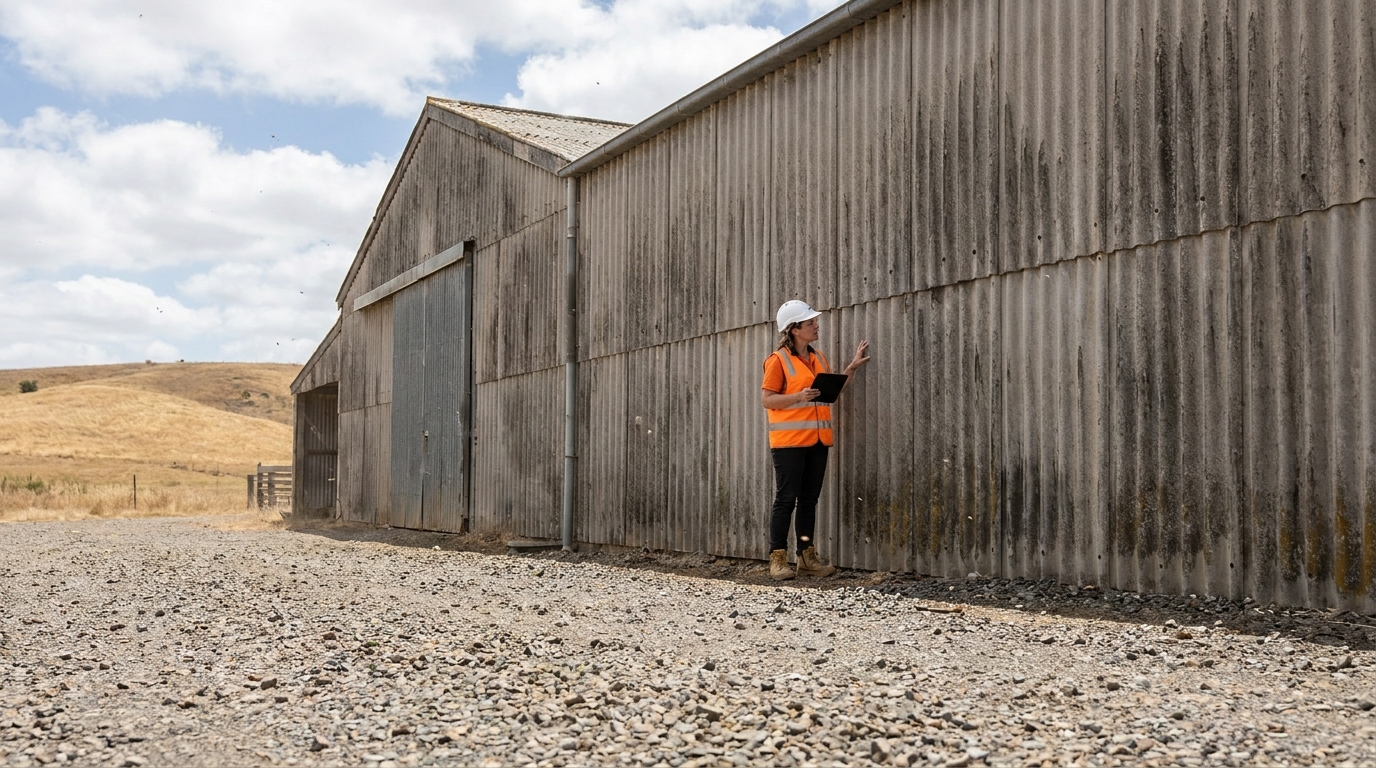
What does asbestos and hazardous materials due diligence involve in an acquisition?
Asbestos due diligence in a sale, purchase, lease or business acquisition checks three things: whether the buildings and plant meet workplace asbestos duties (an asbestos register and management plan where required), what other hazardous building materials are present (such as lead paint, PCBs, synthetic mineral fibres and ozone depleting substances), and whether asbestos is in the soil or fill. The findings are then costed against the buyer’s plans, because a building that is safe to occupy can still need expensive removal before refurbishment or demolition. That cost evidence lets a buyer protect itself through price, warranties, indemnities and retentions, and lets a seller defend its price with a clear, documented position.
Asbestos rarely kills a deal on its own. What hurts buyers is the asbestos nobody priced: the roof sheeting that may have to come off before a solar install, the vinyl tiles under the carpet in a planned fit out, or the fibre cement fragments in fill that turn a simple earthworks job into licensed removal and asbestos waste disposal. Good asbestos due diligence finds and costs these items before the price is fixed.
This is the eighth article in our series on environmental due diligence (EDD) for M&A in Australia. Earlier articles covered why environmental due diligence matters in Australian M&A, Phase 1 vs Phase 2 environmental assessments, negotiating price, warranties, indemnities and escrow, vendor environmental due diligence, PFAS liabilities in transactions, contaminated land registers and notices by state and UPSS due diligence on service station and industrial sites. This one covers asbestos and other hazardous building materials, in buildings and in the ground.
Why asbestos due diligence matters in acquisitions
Australia banned all forms of asbestos from 31 December 2003, but asbestos containing material (ACM) was used widely in building products for decades before that. Fibre cement sheeting, roofing, eaves linings, vinyl floor tiles and their backing, pipe lagging, electrical switchboards, gaskets and brake linings in plant are all common. Most of it is low risk while it is in good condition and left undisturbed. The risk, and the cost, arrive when it is damaged, disturbed or has to be removed. Asbestos has also turned up in products imported since the ban, so a newer building is not automatically clear.
For a buyer, that creates four separate questions:
- Compliance. Does the current owner or operator meet its workplace duties, and what will the buyer need to fix when it takes over management or control?
- Condition. Is any ACM damaged or deteriorating and in need of action now, regardless of the buyer’s plans?
- Plans. What will it cost to remove asbestos and other hazardous materials that the buyer’s refurbishment, demolition or redevelopment will disturb?
- Ground. Is there asbestos in soil or fill, often from past demolition or imported fill, that will affect earthworks, waste disposal and future land use?
Asbestos registers and management plans: what a buyer should ask for
The model Work Health and Safety (WHS) Regulations apply in every state and territory except Victoria. Under them, the person with management or control of a workplace must ensure, so far as is reasonably practicable, that asbestos and ACM at the workplace are identified by a competent person, or assume it is present. They must keep an asbestos register at the workplace and, where asbestos is identified, assumed or likely to be present, a written asbestos management plan. A register is not required for a building constructed after 31 December 2003 where no asbestos has been identified and none is likely to be present. Queensland uses an earlier date: the exemption applies only to buildings constructed after 31 December 1989, so pre-1990 workplace buildings there need a register.
Under the model Regulations and Safe Work Australia’s code of practice:
- the register records identified or assumed asbestos, including its location, type and condition, and inaccessible areas likely to contain it
- the register must be reviewed and revised when the management plan is reviewed, when further asbestos is identified, when asbestos is removed, disturbed, sealed or enclosed, and before refurbishment or demolition, and the code says it should be reviewed at least every five years
- the asbestos management plan must be reviewed at least once every five years and at other trigger points
- a person relinquishing management or control of a workplace, for example on a sale of the property or the business, must so far as is reasonably practicable give a copy of the register to the person taking over.
Victoria applies its own Occupational Health and Safety Regulations 2017 and WorkSafe Victoria’s compliance code. The core duties are similar, including identifying asbestos so far as is reasonably practicable, keeping an asbestos register and providing it to the person taking over management or control. The terms and details differ, though, so Victorian deals should be checked against the Victorian rules.
The workplace register and management plan duties do not apply to residential premises, although demolition and refurbishment of homes still carry asbestos identification and removal duties. In NSW and the ACT, homes affected by loose-fill asbestos insulation are listed on public registers, which is worth checking in residential portfolio deals.
In a data room, ask for the current register and management plan, the survey reports behind them, asbestos removal control plans, air monitoring results, clearance certificates and any notices or incident reports. Then read them critically. A register that is years out of date, presumes asbestos across whole buildings or excludes roof spaces, wall cavities and plant as inaccessible may be lawful, but it tells a buyer little about cost. A missing register on a workplace building that needs one is a compliance gap the buyer will inherit, and a sign that other building records may also be thin.
Hazardous materials surveys: what they cover
A hazardous materials survey, often called a hazmat survey, goes beyond asbestos. Its scope should match the age and use of the buildings and the buyer’s plans, but it commonly covers:
- Asbestos and ACM in building fabric, services and plant, with sampling of suspect materials and analysis by a NATA accredited laboratory.
- Lead paint. Buildings painted before 1970 are most at risk, because older paints could contain very high levels of lead. Permitted levels were cut in stages until the late 1990s. Lead dust in roof spaces and paint flakes in surrounding soil are related issues.
- Polychlorinated biphenyls (PCBs) in older electrical equipment, such as capacitors in fluorescent light fittings in buildings built or refurbished before about 1980, and older transformers. PCB waste has specific management and disposal requirements.
- Synthetic mineral fibres (SMF) in insulation, ceiling tiles and pipe and duct lagging. These are not asbestos, but they need dust and handling controls when disturbed.
- Ozone depleting substances (ODS), such as older refrigerants in air conditioning and refrigeration plant and halon in older fire protection systems. Under the Commonwealth Ozone Protection and Synthetic Greenhouse Gas Management Act 1989, recovery and decommissioning of these, and of synthetic greenhouse gas refrigerants, must be done by appropriately licensed or permitted technicians.
Two survey types matter in a deal. A management survey supports the asbestos register for the building as it is used today. It is minimally intrusive and lists areas that could not be accessed. A pre-demolition or pre-refurbishment survey is intrusive. It opens up walls, ceilings, floors and plant in the areas that will be disturbed, because the WHS Regulations require asbestos likely to be disturbed by demolition or refurbishment to be identified and, so far as is reasonably practicable, removed before the work starts. If there is no register, the work must not start until a competent person has determined whether asbestos is present.
The difference drives cost. A building can have a clean, compliant register and still hide ACM in wall cavities, under floor coverings or in plant that only an intrusive survey will find. If the buyer plans to strip out, extend or demolish, a management survey alone is not enough to price the work.
Surveys are carried out by a competent person, typically an occupational hygienist or experienced asbestos assessor. Licensing is a separate question. Licensed removalists are needed for friable asbestos and for non-friable asbestos above a small-area threshold, and a licensed asbestos assessor is needed for air monitoring and clearance on friable removal. In an EDD scope, the value lies in matching the survey to the buyer’s plans, checking its limitations and reading it alongside the land contamination findings, so the deal has one costed picture.
Asbestos in soil and fill
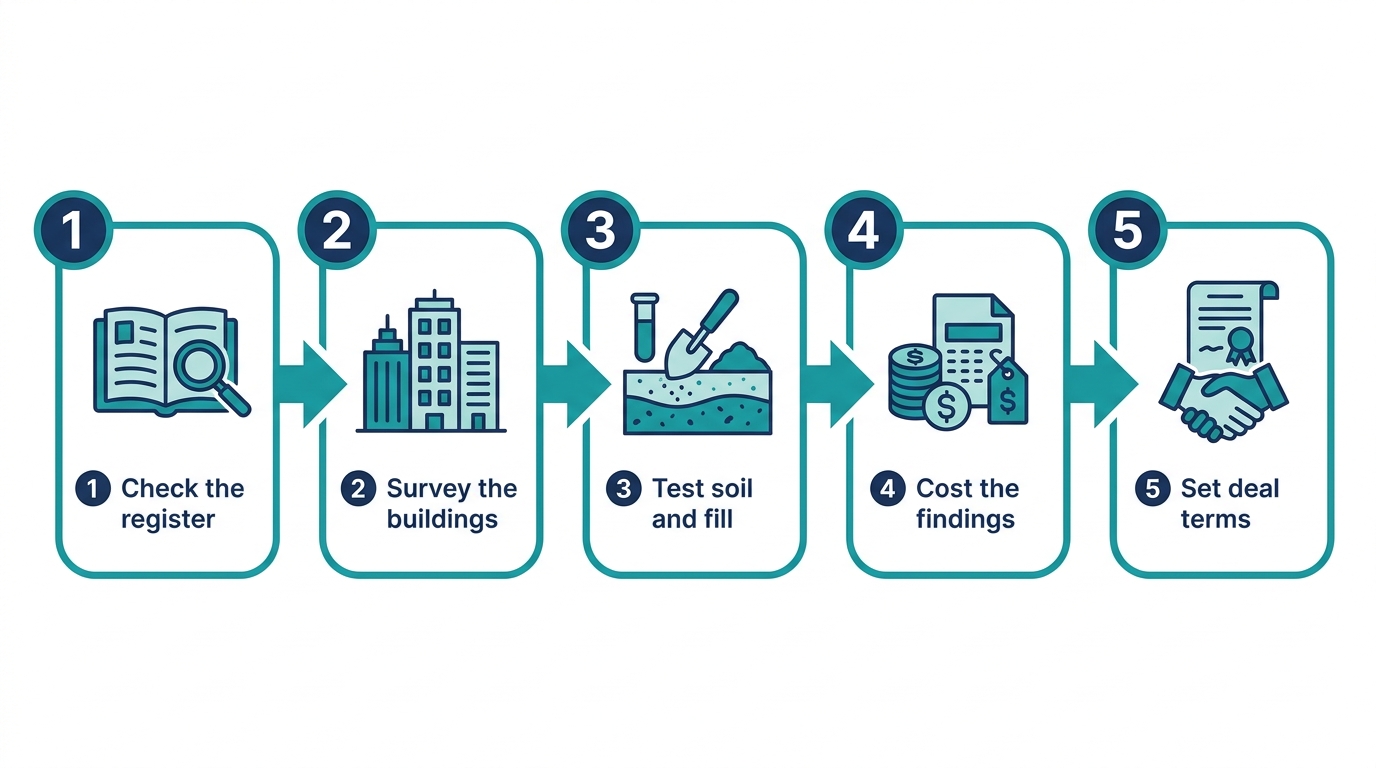
Asbestos in the ground is a separate problem with its own framework. It typically comes from buildings demolished without proper removal, building rubble mixed into fill, buried sheds and fences, and imported fill that was never what it claimed to be. Former industrial and rural sites, old house lots being consolidated for development and sites with filled ground are the usual suspects.
The National Environment Protection (Assessment of Site Contamination) Measure 1999, as amended in 2013 (the ASC NEPM), added guidance on asbestos in soil to Schedules B1 and B2, adapted from the 2009 Western Australian Department of Health guidelines. It sorts asbestos into bonded ACM, fibrous asbestos and asbestos fines, measures it gravimetrically as a percentage by weight (% w/w) of soil, and compares the result with health screening levels that depend on land use. The levels for bonded ACM range from 0.01% w/w for residential land with accessible soil to 0.05% w/w for commercial and industrial land. The level for fibrous asbestos and asbestos fines is 0.001% w/w for all land uses, and surface soil should have no visible asbestos. These are screening levels: an exceedance triggers further assessment or management, not automatic removal. Our article on asbestos in soil assessment in Australia explains the method in detail.
For a transaction, three points matter:
- Land use changes the answer. A level of bonded ACM that is acceptable on a commercial site may exceed the screening level for a residential subdivision or a childcare centre. Due diligence should test the site against the buyer’s intended use, not just the current one.
- Earthworks drive the cost. Asbestos in fill that is capped and left alone may be manageable. The same fill becomes expensive when it has to be excavated, because asbestos contaminated soil generally needs licensed or controlled removal, careful waste classification and disposal at a facility licensed to accept it. Hand picking, screening and on-site management can sometimes reduce the volume that has to go off site, as in our asbestos impacted soil remediation at an industrial site in Victoria.
- Stockpiles and imported fill are traps. Soil stockpiled on a site, or fill brought in with a clean certificate, can carry asbestos fragments. Our articles on asbestos in stockpiles of soil and when clean fill isn’t clean cover what to check.
Asbestos in soil is usually picked up in a preliminary site investigation through site history, aerial photographs and a walkover, then confirmed through test pits and gravimetric sampling in a detailed site investigation where the risk warrants it. Test pits are generally preferred to boreholes because they expose far more soil to inspection.
Demolition and refurbishment plans change the scope
The most useful thing a buyer can tell its consultant is what it plans to do with the site. Holding a building as an investment needs a different level of investigation from stripping it for a new tenant, replacing the roof or demolishing for residential development.
Where demolition or major refurbishment is likely, the due diligence should include, or at least scope and price, a pre-demolition or pre-refurbishment hazardous materials survey of the affected areas, and soil investigation of the footprint and any filled ground. It should also allow for the practical consequences: licensed removal, air monitoring and clearance inspections, waste transport and disposal, and the program time all of this adds before construction can start. Asbestos found under slabs or in footings once demolition starts is a frequent cause of delay and variation claims.
Where access for an intrusive survey is not possible before exchange, for example because the building is tenanted, the gap should be stated plainly and handled in the deal terms rather than ignored.
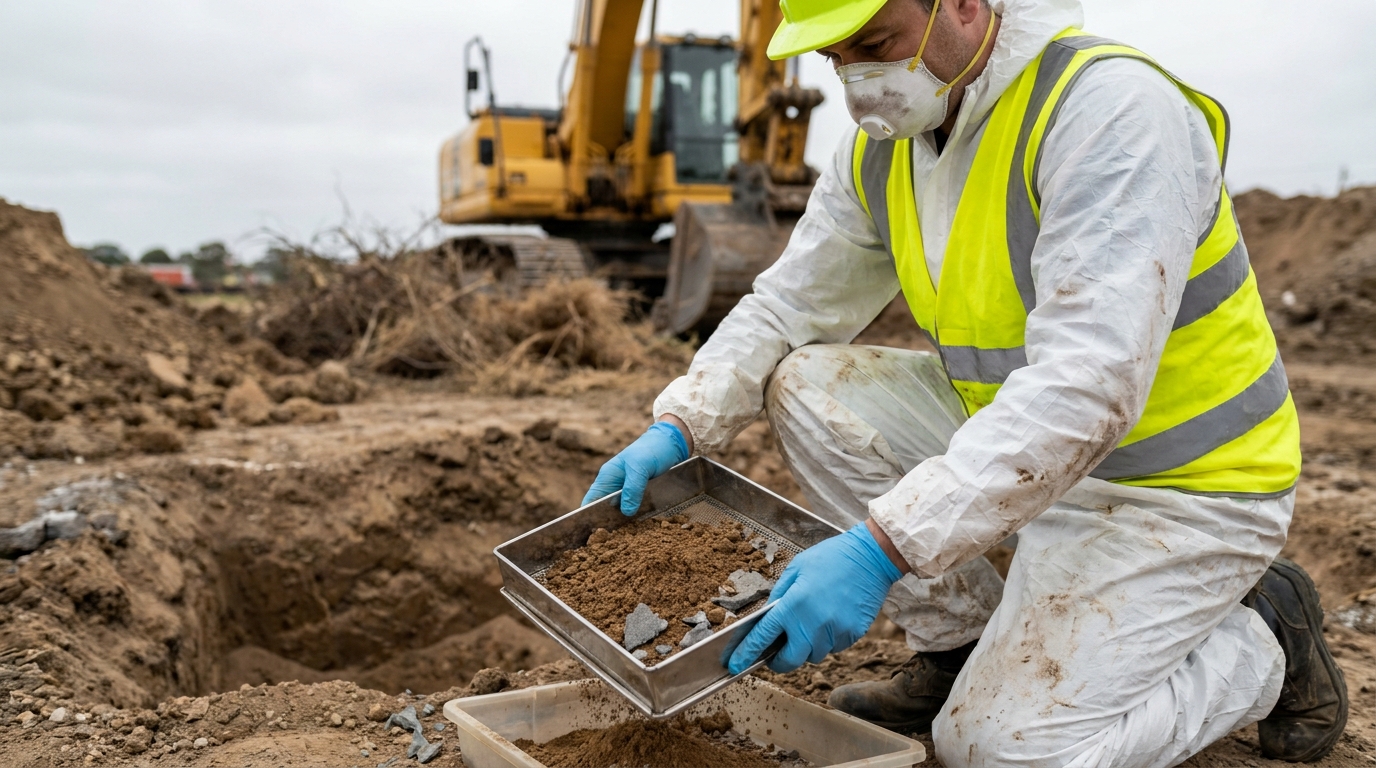
How asbestos due diligence findings flow into cost estimates and deal terms
Findings are only useful if they are turned into numbers and allocated. We generally sort asbestos and hazardous materials findings into three cost buckets:
- Immediate compliance costs, such as updating or preparing the register and management plan, labelling, and dealing with damaged ACM that needs action now.
- Plan driven costs, such as removal ahead of refurbishment or demolition, PCB and ODS decommissioning, and lead paint management, each linked to the buyer’s program.
- Ground costs, such as investigation, remediation, validation and waste disposal for asbestos in soil, scaled to the intended land use and the volume of earthworks.
Each estimate should state its assumptions and give a realistic range. Our article on negotiating price, warranties, indemnities and escrow covers the general tools. For asbestos and hazardous materials, they usually look like this:
- Price. Known, reasonably certain costs, such as removing asbestos roofing before a planned upgrade, are often best dealt with as a price adjustment.
- Warranties. That the register and management plan are current, that all survey, removal and clearance records have been disclosed, and that no notices or incidents are outstanding.
- Specific indemnities. For uncertain items, such as asbestos found during demolition of a specified building or in fill under a slab that cannot yet be tested, with clear triggers, caps and time limits.
- Escrow or retention. Part of the price held back until removal and clearance, soil remediation and validation, or a deferred intrusive survey is complete.
- Conditions and pre-completion works. The seller removes specified ACM before completion, using licensed removalists, with a clearance certificate from an independent assessor.
One limit applies to all of these. WHS duties cannot be contracted out of. Warranties and indemnities move cost between the parties, but they do not move the duty. A buyer that takes management or control on completion holds the workplace asbestos duties from that day, so it needs a plan to adopt or refresh the register and management plan straight away.
Deal structure matters. In a property or asset purchase, the buyer takes on the buildings and land and the duties that come with management or control. A business bought as assets and operating from leased premises usually takes on duties as a tenant, shared with the landlord. In a share sale, the duty holder does not change, but the company’s history comes with it, including any past non-compliance, notices or exposure incidents. In a lease, the parties should settle who holds and updates the register, the baseline condition of the premises, and who pays for asbestos removal at make-good.
For sellers, the same work protects price. A current register, a recent survey that matches a likely buyer’s plans and a soil investigation where fill is suspected let a seller answer questions with evidence and stop a buyer from pricing in a worst case. Our article on vendor environmental due diligence explains how to prepare.
State and territory notes
The framework is broadly national, but details differ. The points below are general and current at the time of writing.
- New South Wales, South Australia, Tasmania, the ACT, the Northern Territory and Western Australia apply WHS laws based on the model laws, with the 31 December 2003 register date. Western Australia adopted its WHS laws in 2022. Its Department of Health asbestos guidelines for contaminated sites, first issued in 2009 and updated in 2021, are the source the NEPM asbestos guidance was adapted from.
- Queensland applies the WHS framework but uses 31 December 1989 as the building date for the register exemption. Asbestos waste is a regulated waste under Queensland environmental protection laws.
- Victoria applies the Occupational Health and Safety Regulations 2017 for workplace asbestos. EPA Victoria regulates asbestos waste and contaminated land under the Environment Protection Act 2017, including the general environmental duty.
- All states and territories regulate the transport and disposal of asbestos waste, and some track it, so disposal costs and the availability of licensed facilities vary from region to region.
Whether asbestos in soil triggers a contaminated land reporting duty or planning requirement depends on the state and the circumstances. Our article on the NSW duty to report contamination explains how this works in NSW.
Common mistakes we see
- Treating a compliant asbestos register as proof the building is free of costly asbestos.
- Relying on a management survey when the buyer intends to refurbish or demolish.
- Ignoring plant and services, such as switchboards, gaskets, lagging and old refrigeration plant.
- Assessing asbestos in buildings but not in the soil and fill around and under them.
- Testing soil against the current land use rather than the buyer’s intended use.
- Leaving survey gaps unpriced rather than covering them with a retention or indemnity.
- Assuming warranties or an indemnity pass the buyer’s WHS duties back to the seller.
Why iEnvi specialises in asbestos and hazardous materials due diligence for transactions
We help buyers, sellers, lenders and their lawyers turn asbestos and hazardous materials findings into costed advice they can negotiate with. Our work includes:
- Asbestos in soil assessment, remediation and clearance, such as our asbestos source assessment and clearance at a development site in south-west Sydney and a soil and asbestos investigation for a school development in northern Melbourne.
- Scoping hazardous materials surveys to the buyer’s plans and combining the results with contaminated land findings into one cost picture.
- Managing asbestos risk during earthworks and waste classification, such as our PFAS and asbestos management for trench and pit works in Brisbane.
- Remediation and validation where asbestos in soil has to be removed or managed.
Where a deal needs an occupational hygienist, a licensed asbestos assessor or a licensed removalist, we scope the work, coordinate appropriately qualified and licensed specialists, and bring their findings into one report for the deal team.
Our work is led by Michael Nicholls, a Certified Environmental Practitioner (CEnvP) Site Contamination Specialist. See our team and credentials and our environmental due diligence for property transactions and M&A service.
Talk to iEnvi about asbestos in your transaction
If you are buying, selling, leasing or financing older buildings or filled land, talk to us before the due diligence period starts. We can scope the register review, hazardous materials survey and soil investigation around your plans and timetable, cost the realistic outcomes and give your advisers findings they can use. Send us a message through our contact page.
This article is general information only and is not legal or financial advice. Asbestos, work health and safety, waste and contaminated land requirements differ between states and territories and change over time, so get advice that suits your deal and sites.
References
- Safe Work Australia. Model Code of Practice: How to manage and control asbestos in the workplace and Asbestos registers at the workplace guidance.
- Safe Work Australia. Model Code of Practice: How to safely remove asbestos.
- Model Work Health and Safety Regulations, Chapter 8 (Asbestos).
- Queensland Government. Asbestos registers for workplaces (asbestos.qld.gov.au).
- Occupational Health and Safety Regulations 2017 (Vic) and WorkSafe Victoria, Compliance code: Managing asbestos in workplaces.
- Environment Protection Act 2017 (Vic).
- WorkSafe WA. Asbestos register and asbestos management plan.
- National Environment Protection (Assessment of Site Contamination) Measure 1999, as amended 2013, Schedules B1 and B2.
- Western Australian Department of Health. Guidelines for the Assessment, Remediation and Management of Asbestos-Contaminated Sites in Western Australia (2009, updated 2021).
- Australian Government. Lead Alert: The six step guide to painting your home.
- Ozone Protection and Synthetic Greenhouse Gas Management Act 1989 (Cth).
Need advice on this issue? iEnvi provides practical, senior-led environmental consulting across contaminated land, remediation, ecology and environmental risk.
PSI services DSI services UPSS investigation and validation Team credentials Talk to iEnvi