

Why do environmental licences and compliance history matter in a business or property deal?
Many operating businesses can only lawfully run if they hold an environmental licence, authority or permit from a state regulator, and those approvals carry conditions, reporting duties and a track record that a buyer takes on. Environmental licence due diligence checks that the right approvals exist, that they match what the site really does, that the compliance history is clean or at least understood, and that each approval can move to the buyer, or stay with the business, on the timetable the deal needs. Problems found before signing can be fixed, priced or allocated through warranties, indemnities, conditions precedent and retentions. Problems found after completion usually land on the buyer.
Buyers often ask about contamination first and licences second. That order can hide a problem. A site may be clean on the day of testing and still sit inside a business that has breached its licence for years, runs a process the licence does not cover, or cannot lawfully keep operating once ownership changes. Environmental licence due diligence finds those problems while they can still be priced.
This is the ninth article in our series on environmental due diligence (EDD) for M&A in Australia. Earlier articles covered why environmental due diligence matters in Australian M&A, Phase 1 vs Phase 2 environmental assessments, negotiating price, warranties, indemnities and escrow, vendor environmental due diligence, PFAS liabilities in transactions, contaminated land registers and notices by state, UPSS due diligence on service station and industrial sites and asbestos and hazardous building materials in acquisitions. This one looks at environmental licences, permits and compliance history, and how they shape risk and price.
What environmental licence due diligence covers
A licence is a regulator’s permission to run a potentially polluting activity on stated terms, such as emission limits, waste types and volumes, monitoring, stormwater and wastewater controls, odour, noise and reporting. Breaches can lead to notices, penalties and, in serious cases, prosecution or suspension or revocation of the licence.
For a buyer, three questions sit under every licence.
- Is it valid and does it fit? The approval must cover the activity actually carried out, at the scale actually carried out. Sites often grow past what their licence describes.
- What does the record show? Breaches, incidents, notices and complaints show how the site is run and what upgrades may be coming.
- Will it survive the deal? Depending on the deal structure and the state, the licence may stay put, need approval to transfer, or need to be replaced.
Licence due diligence sits alongside land and groundwater work. A business can comply with its licence and still have contaminated soil from historic operations, because a licence does not clean up the past. That is why this work links to the preliminary site investigation and any later intrusive sampling.
Which approvals to look for
Each state and territory runs its own licensing system, with different names, triggers and transfer rules. The points below are general, current at the time of writing, and no substitute for reading the instrument itself.
New South Wales
Scheduled activities under the Protection of the Environment Operations Act 1997 (POEO Act) need an environment protection licence from the NSW EPA. A licence stays in force until it is surrendered, suspended or revoked, so there is no renewal date, but holders pay annual fees and lodge annual returns, and the EPA reviews each licence at least every five years and can vary its conditions. The POEO public register shows licences, applications, notices, penalty notices, prosecutions, reported non-compliances, audits and licence review dates.
Queensland
An environmentally relevant activity (ERA) under the Environmental Protection Act 1994 needs an environmental authority (EA), and the operator must be a registered suitable operator. EAs can carry conditions such as financial assurance, which matters when a deal changes who holds the authority. The public register includes EAs, registered suitable operators, annual returns and enforcement actions.
Victoria
The Environment Protection Act 2017 uses a tiered system of permissions (licences, permits and registrations) alongside the general environmental duty, which applies to everyone. EPA Victoria’s permissions register shows the holder, activities, location, conditions and status for permissions issued from 1 July 2021, so older history may need a request to the EPA.
Western Australia
Part V of the Environmental Protection Act 1986, administered by the Department of Water and Environmental Regulation (DWER), requires prescribed premises to hold a works approval, a licence or, for some categories, a registration. A works approval covers construction or modification, and a licence covers operation. Check both, and whether the plant as built matches the works approval.
South Australia
The Environment Protection Act 1993 requires an EPA licence for prescribed activities of environmental significance, and also provides for works approvals and exemptions. The EPA’s public register records authorisation conditions, enforcement action, environment protection orders and site contamination notified to the EPA.
Other jurisdictions and local approvals
Tasmania, the Northern Territory and the ACT have their own regimes, with their own transfer rules. Many sites also depend on planning or development approval conditions, dangerous goods or hazardous chemicals licences and notifications, water extraction approvals and trade waste approvals. Ask early for a licence schedule listing every approval, issuer, number, review date and holder.
Share sales, asset sales and what happens to the licence
Share sales
In a share sale, the company that holds the licence stays the same, so the licence does not transfer and there is usually no regulator approval to time. But the buyer takes the company with its whole record, including past non-compliance, unreported incidents, open notices and any prosecution under way. Check the licence conditions and the relevant legislation for any duty to notify the regulator of changes, and check leases, trade waste agreements and finance documents for change of control clauses. If the seller first moves the business into a new subsidiary, the licence must transfer to that entity.
Asset and business sales
In an asset sale, the licence usually has to move to the buyer or be replaced. Liability for the seller’s own past offences generally stays with the seller, but the licence conditions, any improvement program and notices attached to the premises come across with the site. The transfer rules differ.
- New South Wales: the current and proposed holders sign a transfer application lodged with the EPA. The EPA can weigh the proposed holder’s compliance record in deciding whether it is a fit and proper person. If approved, the transfer takes effect on the date nominated in the application, which can be aligned with completion.
- Queensland: the current EA holder applies to transfer the authority, and the transfer can be refused only if the proposed holder is not a registered suitable operator, so the buyer should register early. If the new holder is not the landowner, it must tell the landowner. Any financial assurance is dealt with as part of the transfer, so the buyer may need to provide its own, and an EA for a resource activity is tied to the resource tenure.
- Victoria: with the holder’s agreement, a person can apply to transfer a licence or permit. The regulator must decide within 20 business days, must refuse if the applicant is not a fit and proper person, can attach conditions, and its decision can be reviewed by VCAT.
- Western Australia: a new occupier of prescribed premises must comply with the existing works approval or licence conditions and, within 30 days of becoming the occupier, apply to transfer it or apply for a new one. Failing to do so is an offence. While the application is pending, the new occupier is treated as the holder. Registrations are not transferred; the register is updated when the change is notified.
- South Australia: the EPA must approve a transfer on due application, subject to any condition limiting transfer, but can refuse if it is not satisfied the transferee is a suitable person, having regard to past contraventions, including by its directors.
First, a transfer is an application to a regulator, not a formality, and in several states a buyer with a poor compliance record can be refused. Second, the contract has to settle who lawfully holds each approval on the day the buyer starts operating. Apart from the WA rule above, a buyer should not assume it can run a licensed activity before the transfer takes effect, so completion is usually timed to the approval, or interim arrangements are agreed on legal advice.
Trade waste approvals need the same care. Some water utilities state that an approval is not transferable and the new owner must apply, and others expect new owners to seek fresh consent. Check with the utility early.
How to read compliance history
The public registers are a starting point, not the whole story. They differ in what they cover and how far back they go. Queensland’s enforcement register, for example, does not include warning notices, penalty infringement notices or prosecution outcomes. A thorough review asks for the seller’s own records as well.
- The licence and every amendment. Read the conditions, not just the cover page. Look for pending variations, review notices and improvement programs, such as pollution reduction programs in NSW or transitional environmental programs in Queensland, that commit the business to upgrades by a set date.
- Monitoring and reporting. Emission, discharge, groundwater and stormwater results compared with the limits, plus annual returns.
- Non-compliance and incident records. Reported breaches, pollution incidents, odour or noise complaints and how each was closed out.
- Regulator correspondence. Warning letters, inspection reports, notices, orders, directions and any enforceable undertakings.
- Audits and management plans. Environmental audits, management plans, pollution incident response plans and corrective action registers. See our work on environmental management plans.
- Financial assurance and bonds. Any security the regulator holds. In an asset sale the buyer often has to provide its own before the seller’s is released.
- Waste records. Waste classification, tracking and disposal records. Missing records are a gap worth pricing. See our overview of waste and beneficial reuse.
A site with no recorded breaches is not automatically in good shape, and a site with a few minor ones, promptly closed out, may be well managed. The warning sign is a pattern: repeated breaches of the same condition, unresolved notices, or an operation that has outgrown its approval.
Where licences meet contamination
Licence compliance and land condition are different questions, and a site can pass one and fail the other. Licence records often point to where contamination is most likely, such as bunded storage with a history of spills, wastewater ponds, stormwater discharge points and waste storage areas.
Regulator notices can reach the land as well. Clean-up notices and similar orders can follow a pollution incident (see our guide to EPA clean-up notices and orders). Our article on the NSW duty to report contamination covers when a finding has to be notified, and other states have their own triggers. Always ask whether sampling done for the deal creates a reporting duty.
How findings reduce risk and give price leverage
Licence findings usually turn into a specific cost, a deadline or a contract term, which makes them effective in negotiation. The deal lawyers draft the terms; the due diligence gives them the facts.
For buyers
- Warranties. The seller warrants that all required approvals are held and in force, that the activity matches them, that the business has complied with them, and that no notices, orders or prosecutions exist or are threatened beyond those disclosed. A warranty is only as strong as the disclosure against it, so the due diligence shapes the disclosure letter. Where warranty and indemnity insurance is used, known issues are excluded from cover and contamination often is too.
- Specific indemnities. A known breach, unreported incident or required upgrade can be covered by a specific indemnity for costs such as remediation, upgrade works or responding to enforcement. A warranty claim is harder, because the buyer must prove breach and loss and faces disclosure, caps and time limits. Whether a fine itself can be indemnified is a legal question.
- Conditions precedent. Completion can depend on the regulator approving the transfer, a variation to cover the real activity, or the seller closing out an open notice.
- Retentions and escrow. Part of the price is held back until the transfer is approved, an upgrade is finished or a monitoring period ends. See our article on negotiating price, warranties, indemnities and escrow.
- Price adjustment. Required upgrades, monitoring programs, financial assurance and longer approval timelines can be costed and taken off the price.
- Interim arrangements. If approval may lag completion, the contract can set who holds the approval in the gap, who bears compliance risk and how the seller cooperates.
For sellers
A seller who has reviewed their own licence file first controls the story. Closing out open notices, fixing mismatches between licence and operation and preparing transfer paperwork before going to market removes the grounds for a price cut, and accurate disclosure limits later warranty claims. This is the approach in our article on vendor environmental due diligence. In an asset sale, a seller left holding the licence after completion can still answer for breaches at a site it no longer runs, so it should tie the transfer and the release of its financial assurance to completion.
Landlords, tenants and lenders
Landlords and tenants should be clear on who holds the licence, who pays for upgrades and who deals with the regulator, and lenders will ask the same questions. Many leases treat a change in control of the tenant as an assignment needing consent, so even a share sale may need the landlord. A tenant’s licence breach can become a landlord’s problem if the land is affected, because some regulator notices can be issued to owners. For leased sites, a baseline environmental site investigation at the start of a lease sets the starting point for the make-good.
A five-step approach
This is the process we run.
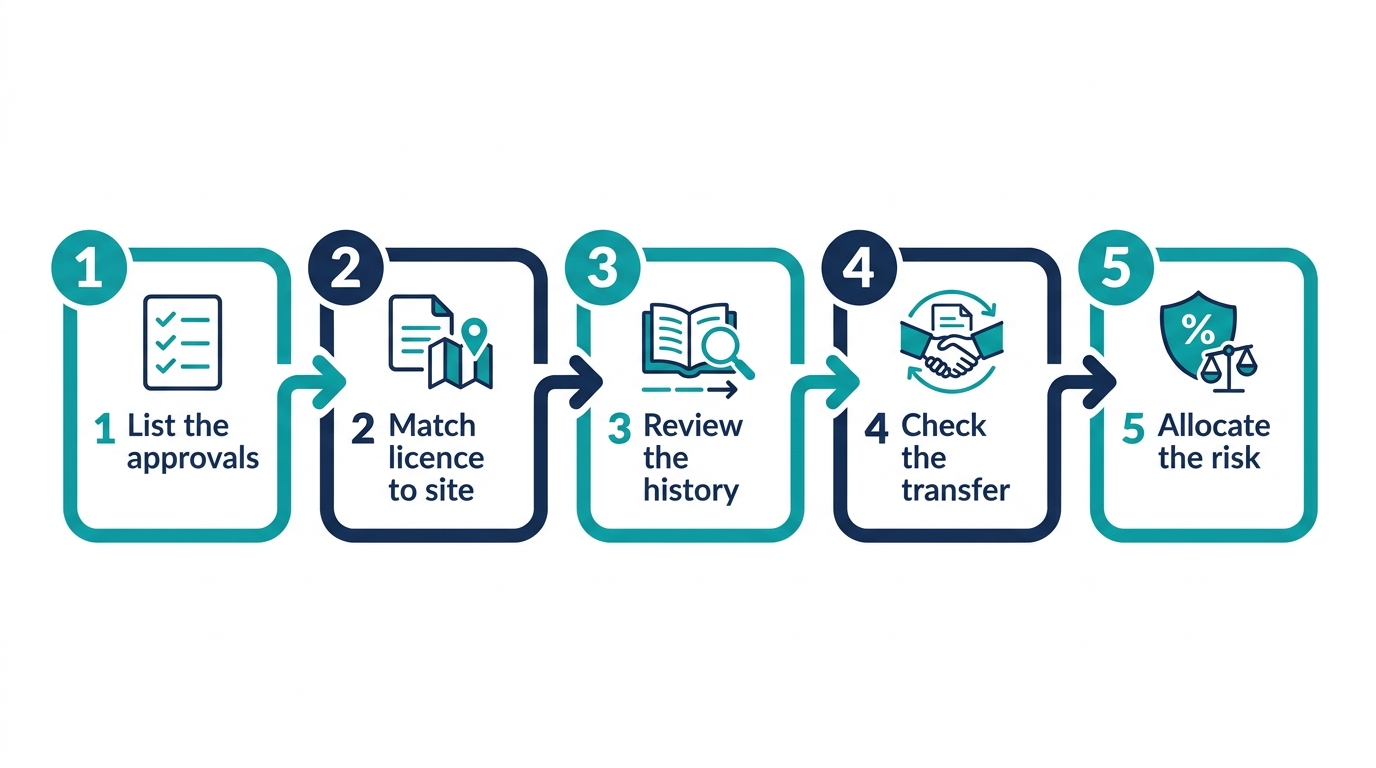
- List the approvals. Build the licence schedule from the seller’s documents and confirm it against the public registers.
- Match licence to site. Compare the approved activities, volumes and conditions with a site inspection and the business’s real processes.
- Review the history. Read monitoring data, incidents, notices and regulator correspondence, and test the seller’s account against them.
- Check the transfer. Work out how each approval moves under the deal structure, who must apply, what the regulator will consider and how long to allow.
- Allocate the risk. Give the deal lawyers findings they can turn into warranties, indemnities, conditions precedent, retentions and price adjustments.
Start early. A regulator will not move faster because a settlement date is close.
Common mistakes
- Treating the licence as a formality and checking only that one exists.
- Relying on a register search alone, when the register may not show everything or go back far enough.
- Assuming a licence moves automatically with the business in an asset sale, or that a share sale needs no consents.
- Leaving transfer applications until after completion, especially where the law sets a deadline for new occupiers.
- Letting the buyer run a licensed activity before the approval is in its name.
- Forgetting ancillary approvals such as trade waste, dangerous goods and water licences.
- Accepting a general compliance warranty without a specific indemnity for known issues.
Why iEnvi specialises in licence and compliance due diligence for transactions
We work on environmental risk in transactions regularly and we see where deals go wrong: a licence that does not match the operation, a transfer left too late, a file full of open notices, or contamination that the licence history pointed to all along. Because we combine regulatory review with site investigation, we can connect the two. A compliance finding becomes a sampling target, and a sampling result is read against the licence history.
Our experience includes compliance and investigation work at metropolitan bus depots, an operational environmental management plan for a wrecking yard, an operational environmental management plan for a food ingredients facility and responses to regulator notices and orders. For more on our process, see contaminated land management and compliance.
Our work is led by Michael Nicholls, a Certified Environmental Practitioner (CEnvP) Site Contamination Specialist. See our team and credentials, our contaminated land services and our environmental due diligence for property transactions and M&A service.
Talk to iEnvi about licences and compliance in your transaction
If you are buying, selling, leasing or financing a business or site that runs under an environmental licence, talk to us before the due diligence period starts. We can scope the environmental licence due diligence around your deal timetable, link it to any site sampling and give your advisers findings they can use in the negotiation. Send us a message through our contact page.
This article is general information only and is not legal or financial advice. Licensing, transfer and register requirements differ between states and territories and change over time, so get advice that suits your deal and sites.
References
- NSW Environment Protection Authority. Guide to licensing and POEO public register guidance.
- Protection of the Environment Operations Act 1997 (NSW).
- Environmental Protection Act 1994 (Qld) and Business Queensland guidance on transferring an environmental authority.
- Environment Protection Act 2017 (Vic), section 56, and EPA Victoria permissions register guidance.
- Environmental Protection Act 1986 (WA), Part V, sections 61 and 64, and DWER guidance on licensing.
- Environment Protection Act 1993 (SA), sections 49 and 109, and EPA South Australia public register guidance.
- Queensland Urban Utilities and Sydney Water trade waste approval guidance.
Need advice on this issue? iEnvi provides practical, senior-led environmental consulting across contaminated land, remediation, ecology and environmental risk.
PSI services UPSS investigation and validation Team credentials Environmental management plans Talk to iEnvi