
How do you put a price on contamination risk in a business or property deal?
You turn each contamination finding into a costed scope of work, a remediation cost estimate, and express it as a range rather than a single figure: a low case, a likely case and a high case or, on more complex sites, probability-based figures such as P50 and P90. The likely cost often supports a price adjustment, the gap between likely and high can support a retention, escrow or capped indemnity, and risks that cannot yet be costed are usually better handled through specific indemnities, seller remediation covenants or conditions precedent. A defensible estimate built from site data gives a buyer leverage and helps a seller protect their price.
In our experience, deals are less often derailed by finding contamination than by not being able to agree what it will cost. A buyer who sees “hydrocarbons above criteria” will often assume the worst and discount hard, and a seller who has never priced the problem has nothing to push back with. The party holding a credible, well-reasoned remediation cost estimate usually sets the terms of the conversation.
This is the tenth article in our series on environmental due diligence (EDD) for M&A in Australia. Earlier articles covered why environmental due diligence matters in Australian M&A, Phase 1 vs Phase 2 environmental assessments, negotiating price, warranties, indemnities and escrow, vendor environmental due diligence, PFAS liabilities in transactions, contaminated land registers and notices by state, UPSS due diligence, asbestos and hazardous building materials and environmental licences and compliance history. This one looks at how to turn findings into remediation cost estimates and contingencies that a deal can actually use.
Why a finding is not yet a number
An environmental report tells you what was found and how it compares with the relevant criteria. It does not tell you what the buyer will have to spend, which depends on the land use, the depth of the impact, whether groundwater is affected and the buyer’s plans.
Take two sites with similar petroleum hydrocarbon results in soil. On the first, the impact sits under a sealed slab that will stay in place under a continued industrial use. If groundwater and vapour risks are acceptable, the practical response may be a management plan and some monitoring. On the second, the buyer plans a redevelopment with basement excavation, so the same soil has to be dug out, classified and either lawfully reused or taken to a facility that can accept it. The finding is the same. The cost is not.
That is why pricing contamination risk starts with the deal and the intended use, not with the laboratory table. The question is not “is it contaminated?” but “what will this buyer, with this plan, be required or choose to do, and what will it cost?” That includes what a regulator could require regardless, for example where contamination is moving off site.
What goes into a remediation cost estimate
A useful remediation cost estimate breaks the response into line items that a contractor or consultant could price. For a typical soil and groundwater problem, that list often includes:
- Further investigation. Extra boreholes, wells or test pits to close the gaps driving uncertainty, usually as part of a detailed site investigation.
- Planning and approvals. A remediation action plan, any council or regulator approvals and, where needed, a site auditor’s review.
- Physical works. Excavation, shoring, dewatering, treatment, stockpile management, dust and odour controls, and backfill.
- Waste classification, transport and disposal. Often the largest single item where soil has to leave the site, covered below.
- Validation. Sampling to show the works met their objectives, and a validation report.
- Groundwater and vapour. Ongoing monitoring, and in some cases treatment or vapour mitigation in new buildings.
- Long-term management. A site management plan, its implementation over time and any notations or ongoing reporting.
- Indirect costs. Program delay, business interruption for an operating site, extra holding costs and the time of the buyer’s own team.
Each line needs a quantity, a rate and a note on confidence. A single lump sum hides where the risk sits.
Disposal is where estimates most often go wrong
Where soil has to leave the site, disposal can dominate the budget. The cost per tonne typically combines the landfill gate fee, the state waste levy (usually collected by the facility and passed on in its charges), transport, any pre-treatment, waste tracking where it applies and the classification testing behind it. Levy rates are generally reviewed or increased each year. As an indicative guide to standard rates for the 2026 to 27 financial year:
- In New South Wales, the standard waste levy is $180.20 per tonne in the Metropolitan Levy Area and $103.80 per tonne in the Regional Levy Area, with concessional rates for some materials (NSW EPA).
- In Queensland, the general levy rate is $135 per tonne in the metropolitan zone and $100 per tonne in the regional zone, with higher rates for regulated waste, for example $215 per tonne for Category 1 regulated waste in the metropolitan zone. Earth contaminated with a hazardous contaminant from land on the Environmental Management Register or Contaminated Land Register attracts the general rate (Queensland Government).
- Victoria and South Australia also apply landfill levies that vary with the waste category and the receiving facility, and other states and territories have their own arrangements.
Those figures are the levy only. Small changes in classification or volume can move the total a long way, which is why good waste classification and reuse planning is one of the most effective ways to bring a remediation estimate down. Material that can be lawfully retained, treated or reused avoids the levy and off-site disposal charges, although treatment, placement, validation and any long-term management still need to be priced.
Where the uncertainty comes from
The ground is only ever sampled, never fully seen. The main sources of uncertainty are usually:
- Extent and volume. How far the impact spreads between sampling points and how deep it goes. This is often the biggest driver.
- Classification. How much of the material falls into each waste category, which sets the disposal route and rate.
- Groundwater. Whether there is a plume, whether it has moved off site and how long monitoring or treatment will run.
- The required outcome. Clean-up objectives depend on the land use, the regulator’s position and, where an audit is involved, what the auditor will accept.
- Unknown sources. Tanks, fill, buried asbestos or PFAS missed because no one did or could look under buildings and slabs.
- Market and timing. Contractor availability, fuel and haulage costs, and levy increases if works are years away.
Some of this can be reduced cheaply before signing and some cannot. Knowing which is which is the heart of pricing contamination risk.
Low, likely and high: building the range
A single number invites argument; a range with the reasoning shown invites negotiation. Most practitioners build three cases:
- Low case. The impact is about as large as the data shows, classification is favourable and the simplest workable response is accepted.
- Likely case. A realistic allowance for spread between sampling points and a sensible mix of waste categories: the figure you would expect to spend.
- High case. A credible worst case, not a disaster: more volume, poorer classification, longer monitoring and extra work a regulator or auditor may ask for.
On larger or more complex sites, the same idea can be expressed in probability terms. A P50 estimate is the cost with about a 50 per cent chance that the final outcome will be at or below it. A P90 estimate has about a 90 per cent chance. These figures come from assigning ranges to key inputs such as volume, rate and duration, and combining them, often with a simple simulation that allows for inputs moving together. P50 and the likely case are close but not identical. Because remediation costs tend to skew upwards, the P50 usually sits a little above the single most likely outcome. The labels matter less than the discipline: with every assumption written down, the parties argue about inputs, not the answer.
Be careful with precision. A probabilistic model built on three boreholes is still built on three boreholes, and thin data is better fixed with targeted sampling than dressed up with decimals.
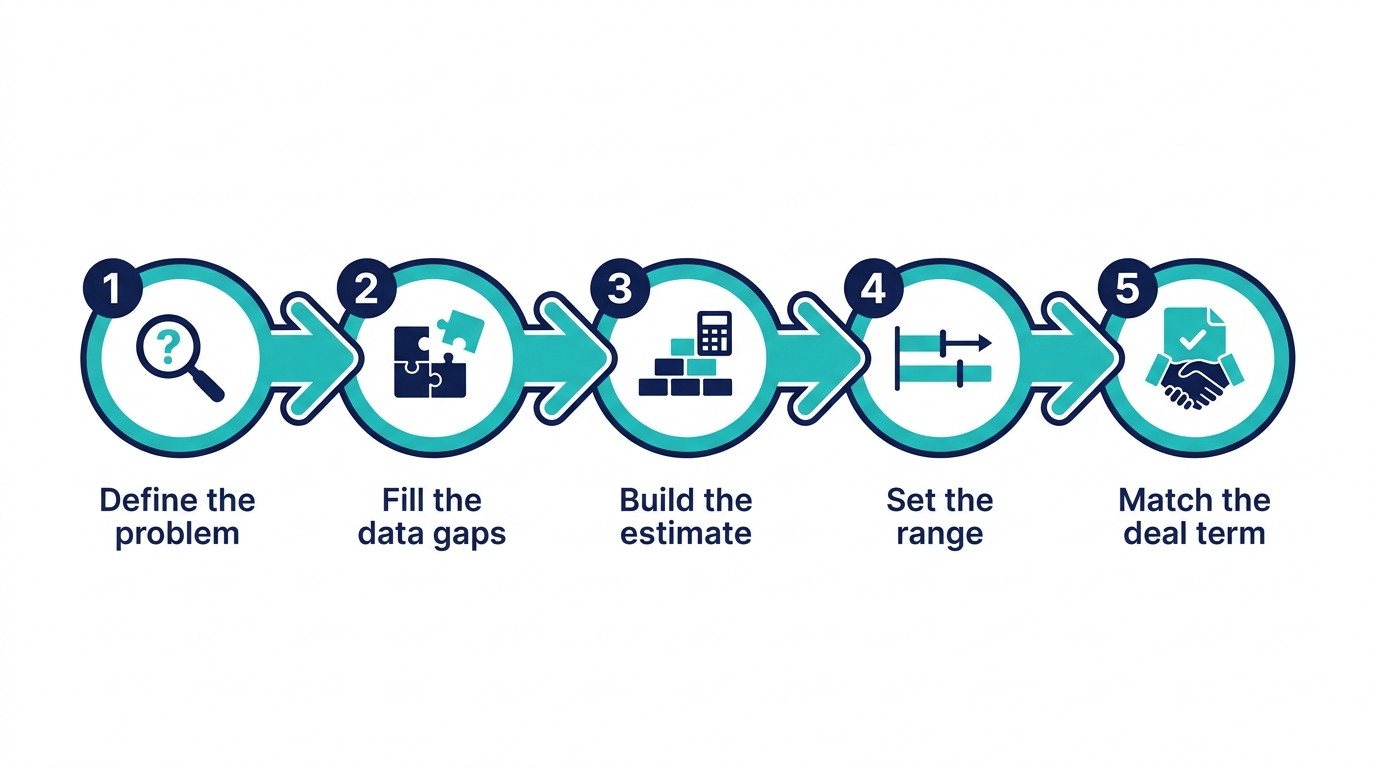
A five-step method for pricing contamination risk
- Define the problem. Set out each issue, the contaminants, the media affected, the intended land use and the outcome the buyer will need, such as a validation report, an audit statement or a management plan.
- Fill the data gaps. Identify which unknowns move the cost most and test them before signing where the timetable allows, for example by stepping out from hot spots or doing in situ waste classification.
- Build the estimate. Price each line item with quantities and rates, using recent contractor and disposal pricing for the region and the levy rates likely to apply when the works happen.
- Set the range. Produce low, likely and high cases, or P50 and P90 figures, and record the assumptions behind each.
- Match the deal term. Decide which part of the range goes into the price, which part sits in a retention or indemnity, and what is left to other contract terms.
Contingency: how much, and where it sits
Contingency is the allowance for things that will probably happen but cannot yet be placed or measured. It is not padding, and it is not the high case. A likely case estimate should normally carry its own contingency for ordinary unknowns, such as a little more volume than modelled or a few extra validation samples. In probabilistic models, contingency is often the difference between the base estimate and a chosen confidence level such as P50 or P90.
Its size depends on the quality of the data. A well-defined extent and simple response may need only a modest allowance. Limited investigation, restricted access or little groundwater data justify a much larger one, and the better answer may be more investigation. There is no standard percentage that suits every site, so ask anyone quoting one to explain it.
In a deal, the real question is who holds the contingency. If it is built into the price, the buyer keeps it whether it is spent or not. If it sits in an escrow or retention, any unspent balance usually goes back to the seller, depending on the release terms. That choice is one of the main levers in the negotiation.
Matching the remediation cost estimate to deal terms
Our earlier article on negotiating price, warranties, indemnities and escrow covers how these tools work. Here the focus is which part of the range each suits:
- Likely case to price adjustment. Where the work is near certain and well defined, the buyer takes a reduction about equal to the likely case and does the work after completion. Clean and final, but the buyer carries any overrun.
- Likely to high gap to escrow or retention. Part of the price is held back, often sized around the gap between the likely and high cases, drawn on if costs run over and released when the works are validated or a set period passes.
- What cannot yet be costed to a specific indemnity. Off-site groundwater, regulator action or third-party claims are hard to price on the day. An indemnity, with a cap and time limit informed by the high case and how long the risk could take to emerge, may deal with them better than a price cut. An indemnity is only as good as the seller’s ability to pay, so it may need backing by a retention, guarantee or insurance, and it does not stop a regulator looking to the owner or occupier.
- Defined works to a seller remediation covenant. The seller agrees to complete defined works before completion, or by a set date afterwards, to an agreed standard, such as a validation report by a suitably qualified consultant and, where required, an audit. The estimate becomes the budget for the seller’s works and the yardstick for any retention if the works slip.
- Cost that could change the deal to a condition precedent. The buyer may make completion conditional on further investigation, a regulator outcome or the seller’s works.
Environmental insurance may sit alongside these tools for unknown or historic contamination, but known conditions are commonly excluded, so policy terms need careful review with a broker and lawyer. Lenders will also want to see the contamination cost dealt with in the deal structure.
An illustrative example
The figures below are hypothetical, used only to show the method, and are not market rates for any site.
Suppose a buyer of an industrial property finds hydrocarbon impact in soil and dissolved hydrocarbons in groundwater around a former fuel storage area. The buyer plans to redevelop, so impacted soil in the footprint will have to be excavated. Based on the investigation, the consultant prices three hypothetical cases.
- Low case, $400,000. The impact is as large as the sampling shows, most of it falls into the lower disposal category and a short period of groundwater monitoring is enough.
- Likely case, $650,000, including contingency. A realistic allowance for spread between sampling points, a mix of waste categories and a year of groundwater monitoring.
- High case, $1,100,000. More volume, more material in a higher category, three years of groundwater monitoring in total and some extra delineation and reporting.
A buyer might seek a price reduction of $650,000 and a retention of $450,000, the gap between the likely and high cases. The retention would be drawn on for any costs above the likely case, with the balance released to the seller once the works are validated. The seller might counter by offering targeted sampling before exchange to narrow the range, or by doing the excavation itself under a remediation covenant if that suits the buyer’s program. Either way, both sides are now arguing about volumes, categories and durations, which can be tested, not fear.
How sellers can protect their price
Sellers lose most when the buyer’s consultant prices the risk first. A seller who commissions vendor environmental due diligence and their own remediation cost estimate can go to market knowing the likely range, close obvious data gaps early and, in some cases, start or complete the works before the sale. A buyer shown a well-reasoned estimate is less likely to apply an arbitrary discount, and a defined scope lets the seller offer a retention or covenant instead of a large price cut.
Common mistakes when pricing contamination risk
- Using a single lump sum with no line items, assumptions or range.
- Pricing the worst case as if it were the likely case, or the best case as if it were certain.
- Forgetting the waste levy, haulage or levy increases when works are some years away.
- Assuming reused or retained soil costs nothing.
- Ignoring delay, business interruption and holding costs.
- Assuming the clean-up objective without checking the land use, the regulator’s likely position or whether an audit will be needed.
- Treating contingency as a fixed percentage regardless of how good the data is.
- Agreeing a retention or indemnity cap that bears no relationship to the high case.
Why iEnvi specialises in pricing contamination risk for transactions
We investigate and manage contaminated sites, and we also scope, supervise and validate remediation. That means our remediation cost estimates are built on what the work actually involves on the ground, including classification, disposal routes, validation and the questions regulators and auditors ask, not just on a desktop allowance. We can tell you which unknowns move the number, design the sampling to narrow them within the deal timetable, and give your lawyers and financial advisers a range they can use.
Relevant reading from our work includes contaminated soil remediation options in Australia, soil remediation options compared, when a site audit is required, pre-purchase due diligence with waste classification in Western Sydney and cost effective management of asbestos impacted soil at an industrial site in Victoria. For groundwater issues, see our groundwater services.
Our work is led by Michael Nicholls, a Certified Environmental Practitioner (CEnvP) Site Contamination Specialist. See our team and credentials, our contaminated land services and our environmental due diligence for property transactions and M&A service.
Talk to iEnvi about pricing contamination risk in your deal
If you are buying, selling, leasing or financing a site with known or suspected contamination, talk to us before the price is settled. We can scope the investigation around your deal timetable, prepare low, likely and high remediation cost estimates, and give your advisers the technical basis for price, retention and indemnity terms. Send us a message through our contact page.
This article is general information only and is not legal, financial, insurance or accounting advice. Cost figures are indicative or illustrative only. Waste levies, disposal requirements and remediation standards differ between states and territories and change over time, so get advice that suits your deal and sites.
References
- NSW Environment Protection Authority. Waste levy areas and levy rates (2026 to 27 rates).
- Queensland Government. Waste levy rates (2026 to 27), and the Waste Reduction and Recycling Regulation 2023 (Qld).
- National Environment Protection (Assessment of Site Contamination) Measure 1999, as amended 2013 (ASC NEPM).
- EPA Victoria and EPA South Australia waste levy guidance.
Need advice on this issue? iEnvi provides practical, senior-led environmental consulting across contaminated land, remediation, ecology and environmental risk.
DSI services UPSS investigation and validation Team credentials Soil remediation Talk to iEnvi